
The Technical Guide to NaDCC Disinfectant Tablets: Chemistry, Dilution, and Operational Implementation
An objective, technical guide to NaDCC tablets: HOCl chemistry, bleach comparison, pathogen kill rates, ppm dilution charts, and safety protocols.
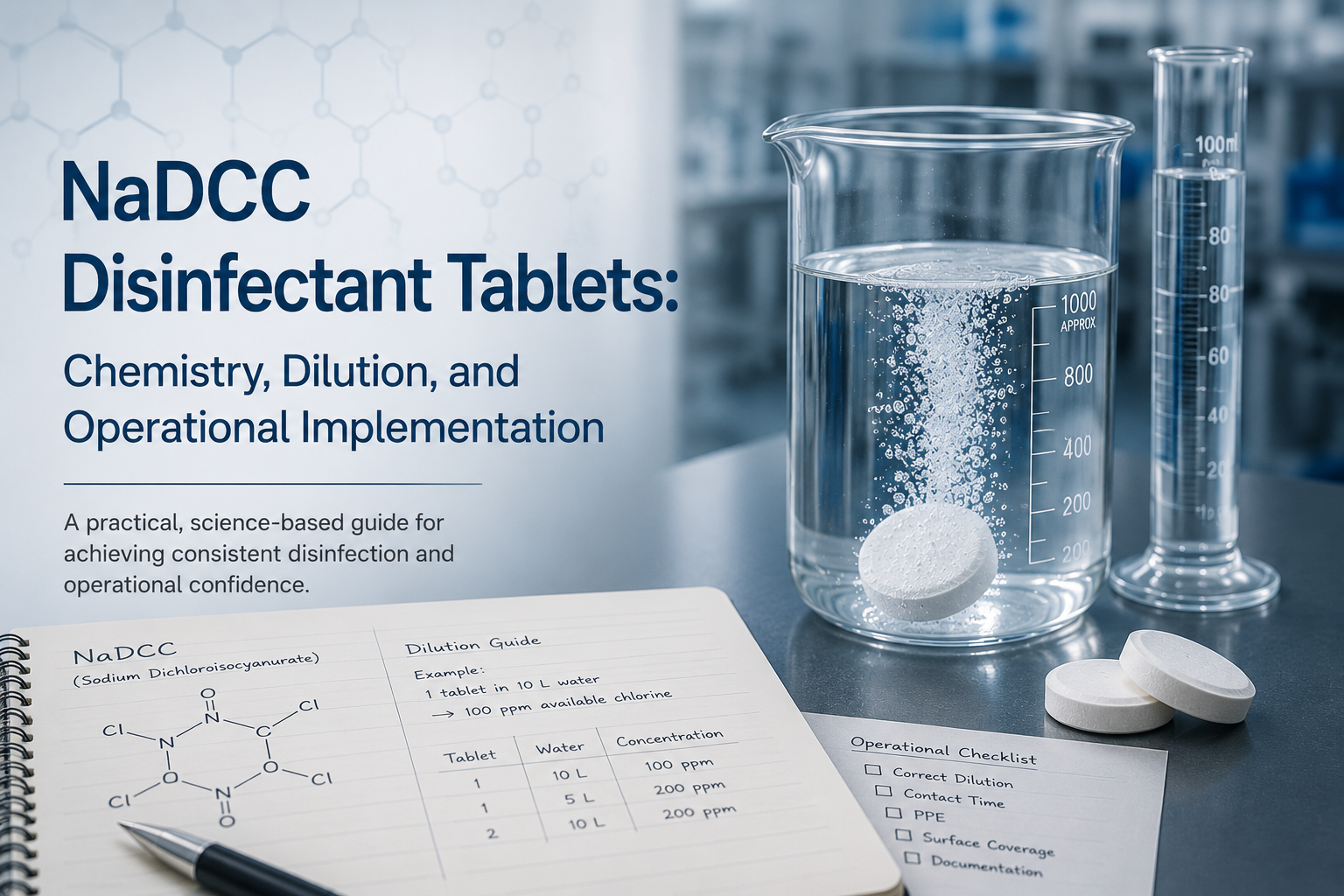
In institutional hygiene, choosing your primary disinfectant means balancing biocidal power, material compatibility, user safety, and storage logistics. Traditional chlorine-releasing agents, specifically liquid sodium hypochlorite, have served as the default option for decades. But liquid bleach is notoriously unstable. It degrades rapidly in storage, sports a highly alkaline pH that eats away at your equipment, and invites high rates of human error during manual dilution.
To fix these vulnerabilities, operations and hygiene managers across healthcare, food processing, and industrial sectors are upgrading to dry-formulated NaDCC disinfectant tablets. This guide delivers an objective, technical evaluation of sodium dichloroisocyanurate. We will break down its chemical mechanisms, compare its performance directly to liquid bleach, examine pathogen-specific kill kinetics, and outline the operational systems you need for consistent implementation across your facility. For a gentler introduction to the compound itself, start with our explainer on what is NaDCC.
What is NaDCC? Understanding the Chemistry of Sodium Dichloroisocyanurate
NaDCC goes by a few names, including sodium dichloroisocyanurate and sodium troclosene. It is a dry, organic chlorine donor. Liquid chlorine degrades fast when heat or UV light hits it, but dry NaDCC remains completely stable. To make our tablets, we blend anhydrous sodium dichloroisocyanurate with acidic and alkaline effervescing agents, like adipic acid and sodium bicarbonate. Toss a tablet into water, and it fizzes and dissolves almost instantly.
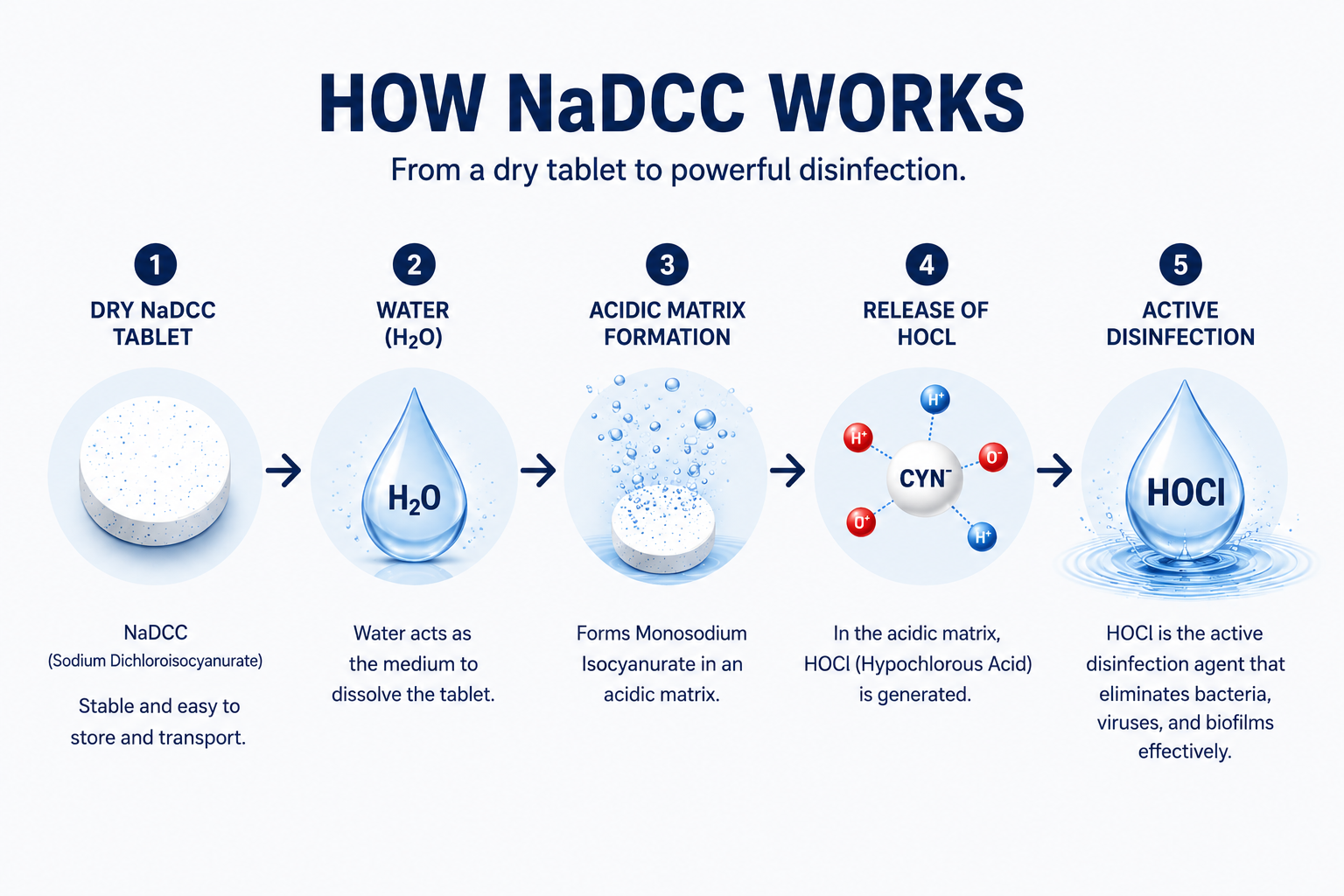
That rapid dissolution releases free available chlorine (FAC). Liquid bleach creates a highly alkaline solution dominated by sluggish hypochlorite ions (OCl⁻). NaDCC does things differently by establishing a dynamic chemical equilibrium. This reaction floods the water with active hypochlorous acid (HOCl), which is the real workhorse of chlorine disinfection.
The Conversion to Hypochlorous Acid (HOCl) vs. Hypochlorite Ions
The actual germ-killing power of any chlorine mix boils down to the ratio of hypochlorous acid (HOCl) to hypochlorite ions (OCl⁻). Both count as free available chlorine. Their performance, however, is night and day.
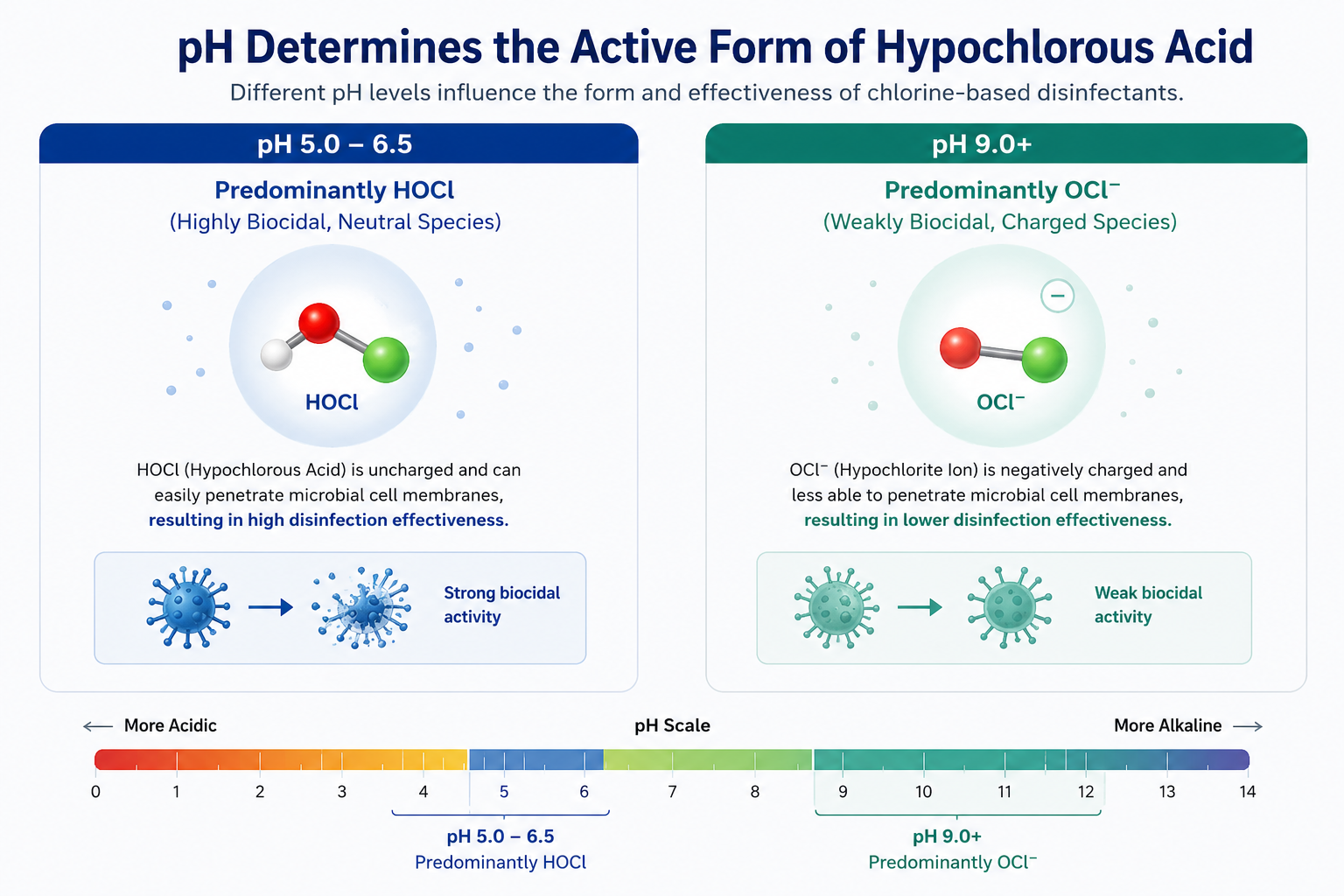
HOCl has a neutral charge. Because of this, it easily slips through the fatty outer membranes of bacterial cell walls to destroy proteins, enzymes, and nucleic acids from the inside. The hypochlorite ion (OCl⁻) carries a negative charge instead. Microorganisms also have negatively charged outer membranes, so they push the ion away. This electrostatic repulsion explains why HOCl is roughly 80 to 100 times more effective at killing pathogens than OCl⁻.
It is a matter of pH. The acidity of the water dictates which molecule dominates:
-
Sodium Hypochlorite (Bleach): This sits at a harsh pH of 11.0 to 13.0. In this alkaline environment, under 10% of the chlorine turns into active HOCl. The rest remains trapped as slow-acting OCl⁻.
-
NaDCC Tablets: These release an acidic byproduct called isocyanuric acid. It acts as a natural buffer, holding the pH between 5.5 and 6.5. This sweet spot ensures over 90% of the chlorine stays as active, fast-acting HOCl. You get a faster, more reliable kill at a fraction of the chemical concentration.
The Chemistry of the 'Reservoir Effect' in Solution
NaDCC relies on a smart chemical process called reversible hydrolysis, which is also known as the reservoir effect. When you drop a tablet in water, it does not dump all its chlorine at once. It holds back.
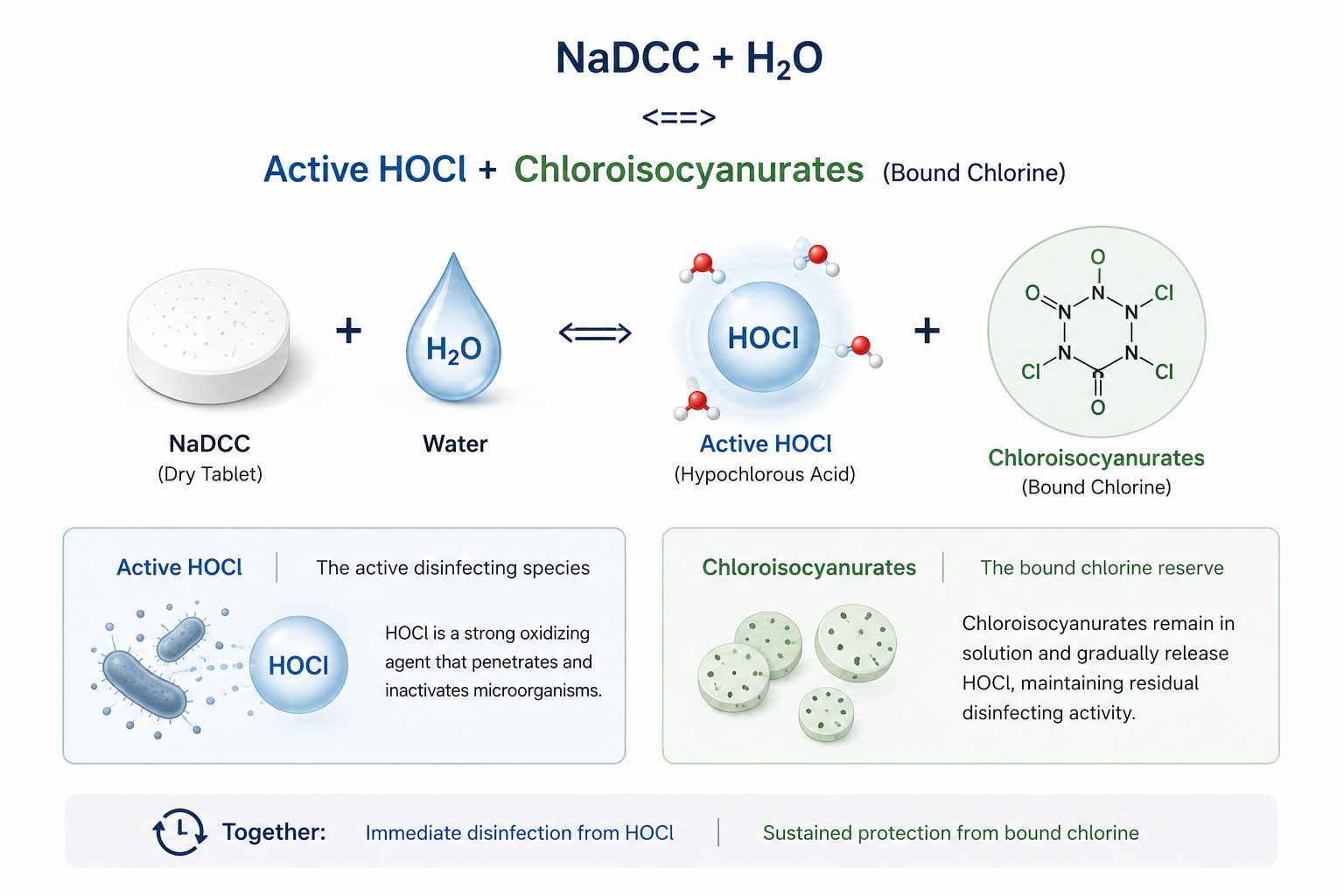
Only about half of the chlorine in the solution works as free active chlorine (HOCl and OCl⁻) at any single moment. The other half stays locked in a chlorinated reservoir.
When the active HOCl gets used up killing microbes or reacting with organic dirt, the chemical balance shifts. The reservoir immediately releases more HOCl to top up the active chlorine levels. This provides two massive practical benefits for daily operations:
-
Longer Lifespan: The solution keeps its sanitizing power active even when tackling dirty, high-traffic surfaces.
-
Less Odor: Because the chlorine is released gradually, you do not get those harsh, choking fumes during a cleaning shift.
NaDCC vs. Sodium Hypochlorite (Liquid Bleach): A Comparative Analysis
For decades, operations managers grabbed liquid sodium hypochlorite because it looked cheap on paper. But buying cheap up front usually costs you down the road. When you tally up chemical waste, constant product degradation, heavy shipping weights, safety mishaps, and ruined surfaces, the financial math shifts toward NaDCC.
Liquid bleach starts losing its strength the second it leaves the factory. Store a standard 5.25% or 6% sodium hypochlorite bottle in normal room temperature conditions, around 25 °C (77 °F), and it can easily drop a fifth of its active chlorine strength in just 90 days. Heat, light, and tiny metal contaminants speed up this decline. This means you cannot trust your dilution math unless your team pulls out test strips for every single bucket, creating a massive loophole for audit failures.
Now consider dry tablets. NaDCC in solid form is incredibly stable. It holds its exact chemical potency for up to 3 to 5 years in unopened packaging, ignoring the humidity and heat shifts that ruin liquid stock.
Corrosion is another operational headache. The harsh alkalinity of liquid bleach, sitting at a pH of 11 to 13, eats building materials for breakfast. It strips expensive floor finishes, rusts structural metal, and destroys the rubber seals inside your auto-scrubbers. Because NaDCC solutions hover near a neutral pH of 5.5 to 6.5, they treat your stainless steel, aluminum, and synthetic floors with respect. For a deeper dive into the trade-offs, read our dedicated comparison of NaDCC vs. sodium hypochlorite.
Comparison Matrix: Technical Performance Parameters
|
Parameter |
NaDCC Disinfectant Tablets |
Sodium Hypochlorite (Liquid Bleach) |
|---|---|---|
|
Physical Form |
Solid, effervescent dry tablet |
Liquid solution |
|
Active Disinfectant Species |
Hypochlorous Acid (HOCl) |
Hypochlorite Ion (OCl⁻) |
|
Solution pH (at dilution) |
Near-neutral (5.5 – 6.5) |
Highly alkaline (11.0 – 13.0) |
|
Active Germicidal State |
~90% active HOCl in solution |
<10% active HOCl in solution |
|
Concentration Stability |
Consistent, predictable dosing per tablet |
Rapid degradation over time (shelf life < 6 months) |
|
Shelf Life (Dry/Unopened) |
3 to 5 years |
3 to 6 months (continuous decay) |
|
Corrosive Profile |
Mildly corrosive; compatible with most metals |
Highly corrosive to metals and floor finishes |
|
Storage & Logistics Footprint |
Low volume, low weight (reduced shipping costs) |
Bulky, heavy liquid storage (hazardous chemical footprint) |
|
Dilution Accuracy |
High precision (pre-measured units) |
Low precision (highly prone to human error) |
Real-World Kill Rates: What it Takes to Neutralize Specific Pathogens
Global health authorities like the US Environmental Protection Agency (EPA) and the World Health Organization (WHO) back the biocidal power of NaDCC. Its strength lies in neutral hypochlorous acid molecules that easily slip through microbial cell walls. Because of this fast-acting penetration, TXDY solutions quickly destroy everything from common bacteria to tough, armored spores.
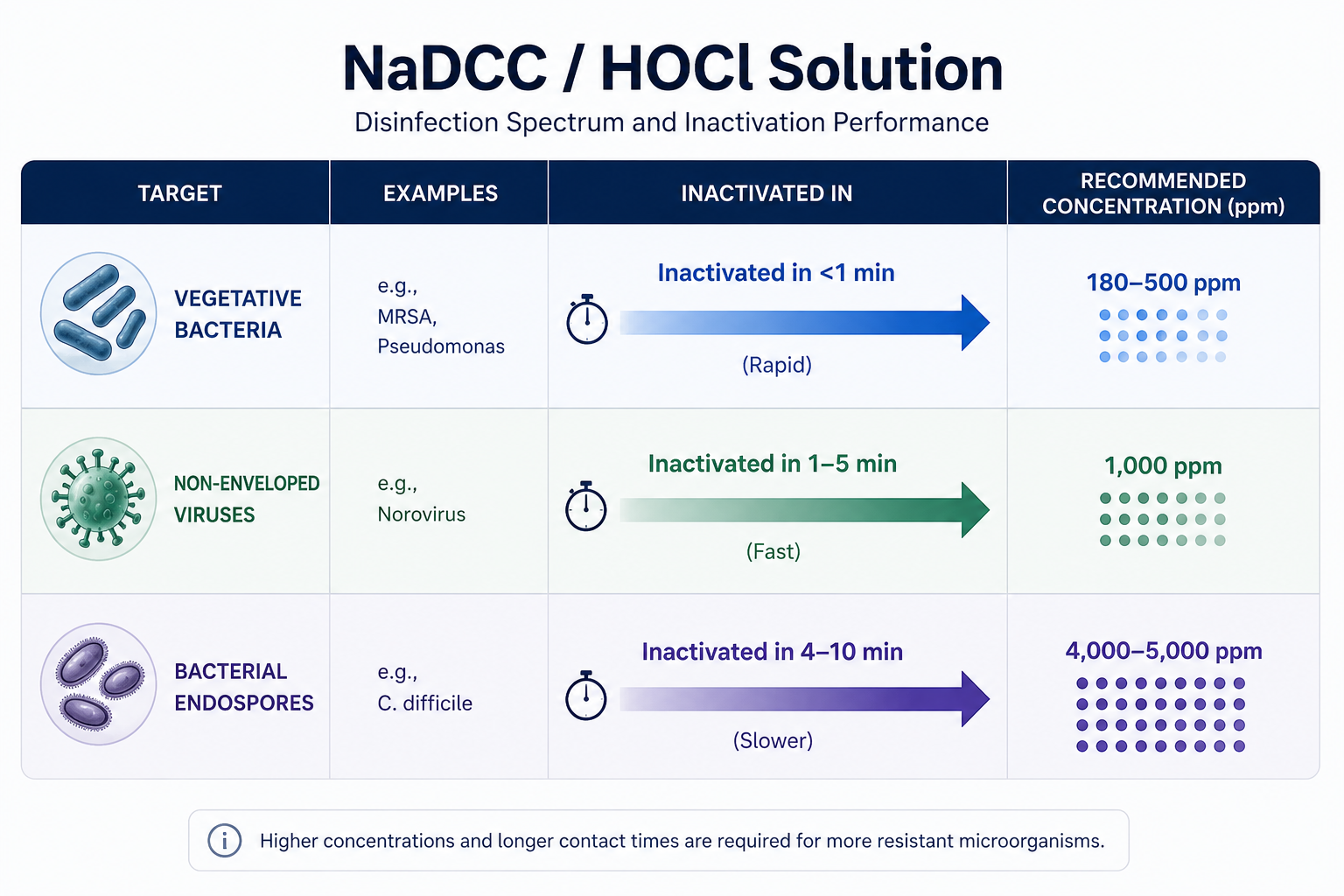
This breakdown shows the exact concentrations of free available chlorine and wet contact times your team needs to hit.
|
Pathogen Class |
Representative Microorganism |
Required FAC Concentration (ppm) |
Required Contact Time |
|---|---|---|---|
|
Enveloped Viruses |
SARS-CoV-2, Influenza A, HBV, HIV |
100 – 500 ppm |
1 minute |
|
Vegetative Bacteria |
Staphylococcus aureus (MRSA), Pseudomonas aeruginosa, E. coli |
500 – 1,000 ppm |
1 to 2 minutes |
|
Fungi & Yeasts |
Candida auris, Trichophyton interdigitale |
1,000 – 1,500 ppm |
2 to 5 minutes |
|
Non-Enveloped Viruses |
Norovirus, Adenovirus, Rotavirus |
1,000 ppm |
1 to 5 minutes |
|
Mycobacteria |
Mycobacterium bovis (TB) |
1,500 – 2,000 ppm |
5 minutes |
|
Bacterial Endospores |
Clostridium difficile (C. diff) spores |
4,000 – 5,000 ppm |
4 to 10 minutes |
Note: These benchmarks assume clean surfaces or standard testing environments. If you are dealing with heavy grime, clean the surface first. Alternatively, bump up your ppm to offset the organic matter soaking up your active chlorine.
How to Calculate Your Target PPM Mix
Getting your disinfection right means knowing how to turn a physical tablet into the exact parts-per-million (ppm) chlorine strength your facility needs.
If you use standard 3-gram NaDCC tablets, which deliver about 1.5 grams of free available chlorine once they hit the water, you can use this reference table to mix your batches:
|
Target Application |
Required Strength (ppm) |
Tablets (3g Unit) |
Water Volume |
Dilution Instructions |
|---|---|---|---|---|
|
Low-level Disinfection |
~100 ppm |
1 |
15 Liters |
Dissolve 1 tablet; ideal for general mopping of low-risk surfaces. |
|
Sanitizing (Food Contact) |
~200 ppm |
1 |
7.5 Liters |
Safe for food contact surfaces; check local regulations regarding rinsing. |
|
General Surface Disinfection |
~500 ppm |
1 |
3 Liters |
Standard clinical/industrial maintenance level for non-critical surfaces. |
|
High-Level / Virucidal |
~1,000 ppm |
1 |
1.5 Liters |
Effective against Norovirus, bloodborne pathogens, and multi-drug resistant organisms. |
|
Critical Outbreak / Spores |
~5,000 ppm |
10 |
3 Liters |
High-potency solution for C. difficile remediation and biological spill cleanups. |
Why Systemized Dosing Beats Manual Mixing
Charts are a great starting point, but expecting busy cleaners to run math on the fly is a recipe for compliance failure. When people eyeball their chemical mixes, they usually get it wrong. They either brew weak, useless solutions that fail audits, or they dump in too much chemical, which eats floor finishes, wastes budget, and fills the room with harsh fumes. Our guide on dilution and concentration walks through the underlying math, including how available chlorine content determines real-world strength.
Legacy brands like Germisep, Dichlosep, Dr. Klēn, and Avotab sell loose tablets in a tub, leaving the heavy lifting to you. Your team has to figure out the math, run the training, and carry the risk if a batch is mixed poorly.
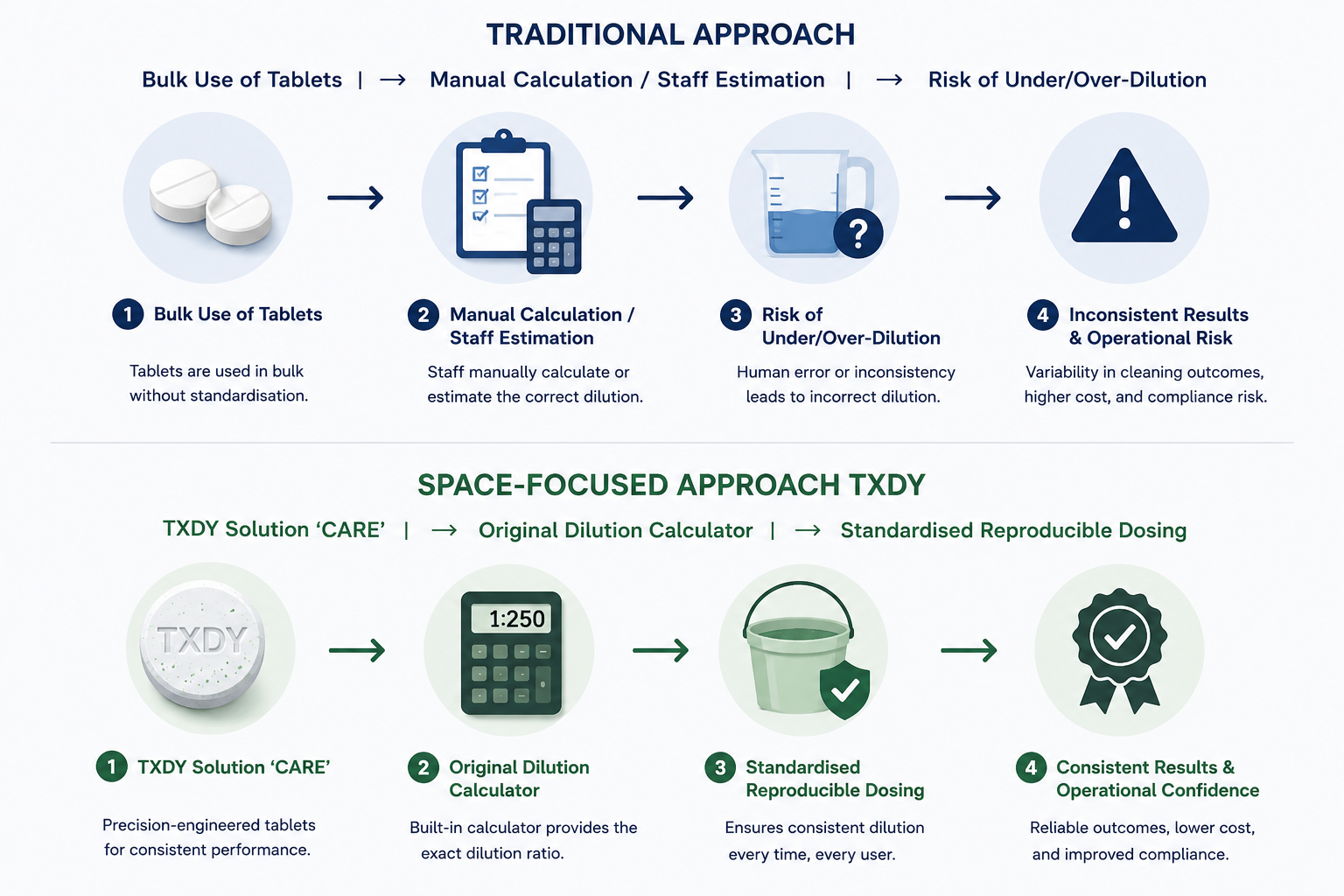
TXDY built an operational ecosystem that pairs physical chemistry with simple digital tools to stop mixing mistakes before they happen. Our foundation is the TXDY PRO SolvTab CARE system, using standardized, pre-dosed 3g NaDCC tablets packed in 333-piece units to keep your high-volume work consistent.
We back this hardware with a free PPM dilution calculator and a surface dilution calculator. Your staff simply types in the bucket size or the surface area and the target job to get an instant, foolproof tablet count. By wrapping pre-measured chemistry in local technical support and clear digital guidance, we help you lock down your hygiene standards and make audits stress-free.
Industry-Specific Applications: From Healthcare to Food Processing
Every sector fights a different biological enemy under its own set of rules. Your threat profile, your physical assets, and your auditors dictate your daily sanitation routine.
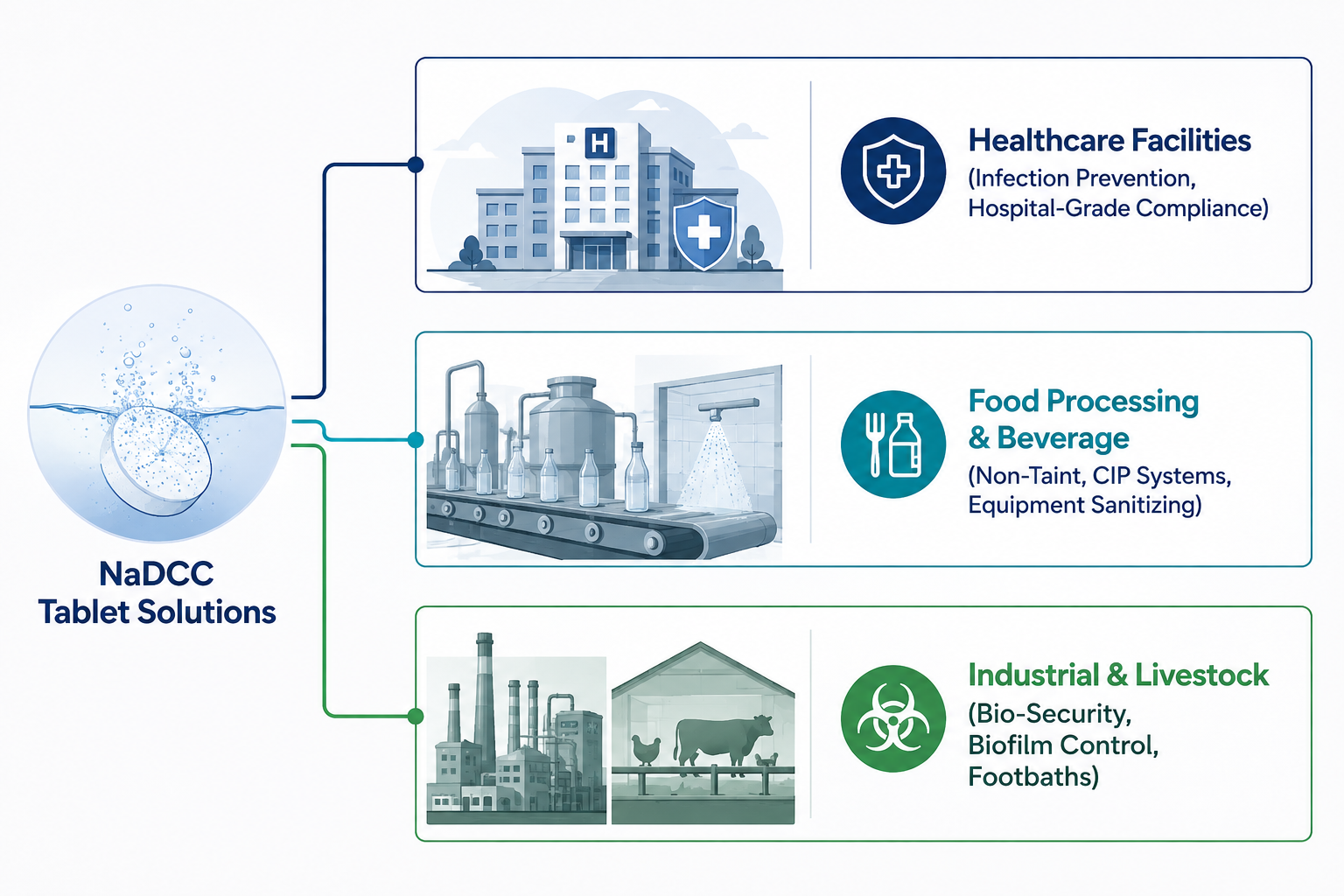
High-Risk Clinical Areas and Hospital Wards
In patient rooms and labs, the main goal is stopping healthcare-associated infections. Tough pathogens like Clostridium difficile spores cling to dry surfaces for months, simply ignoring common quaternary ammonium compound disinfectants.
To destroy these hardy bugs, international infection control leaders trust NaDCC. For instance, Kersia Healthcare's Klorkleen has made this chemistry a global standard for clinical cleaning. These dual-action detergent and disinfectant tablets let busy environmental services teams clean and sanitize in one go, saving precious labor hours.
Closer to home, TXDY brings these same world-class standards to medical facilities across Southeast Asia. By supplying PRO SolvTab CARE alongside practical training and compliance tools, we help local hospitals run tight, predictable disinfection programs that satisfy strict clinical audits.
Food Production, Farming, and Factories
Food and beverage processors must balance raw killing power against chemical safety, odor issues, and run-off rules.
-
No Leftover Odors or Tastes: Quat-based sanitizers can leave sticky chemical films that ruin the taste of food. NaDCC is different because it degrades rapidly after doing its job. Once the active hypochlorous acid neutralizes the target bacteria, it leaves no lingering chemical residue, making it safe for conveyor belts, food prep surfaces, and clean-in-place systems.
-
Destruction of Slime Layers: In water tanks, food piping, and livestock drinking lines, bacteria build thick biofilms that block standard sanitizing sprays. The neutral molecule of NaDCC-derived hypochlorous acid slips straight through this protective slime layer, killing the hidden bacteria and clearing out the pipework. This matters immensely in poultry and livestock farming, where clean drinking water prevents flock-wide disease.
-
A Simpler Way to Treat Surfaces: While systems like TwinOxide use chlorine dioxide effectively for dedicated water treatment, NaDCC tablets are far easier to store and safer for your team to handle during general surface wiping, boot washes, and overall facility scrub-downs.
Safety, Handling, and Compliance Protocols for Facility Managers
Liquid bleach eats away at your equipment and carries real spill risks. NaDCC tablets bypass those headaches, but you are still dealing with a concentrated dry oxidizer before it hits the water. Keeping your team safe and your audits clean requires clear, non-negotiable handling rules.
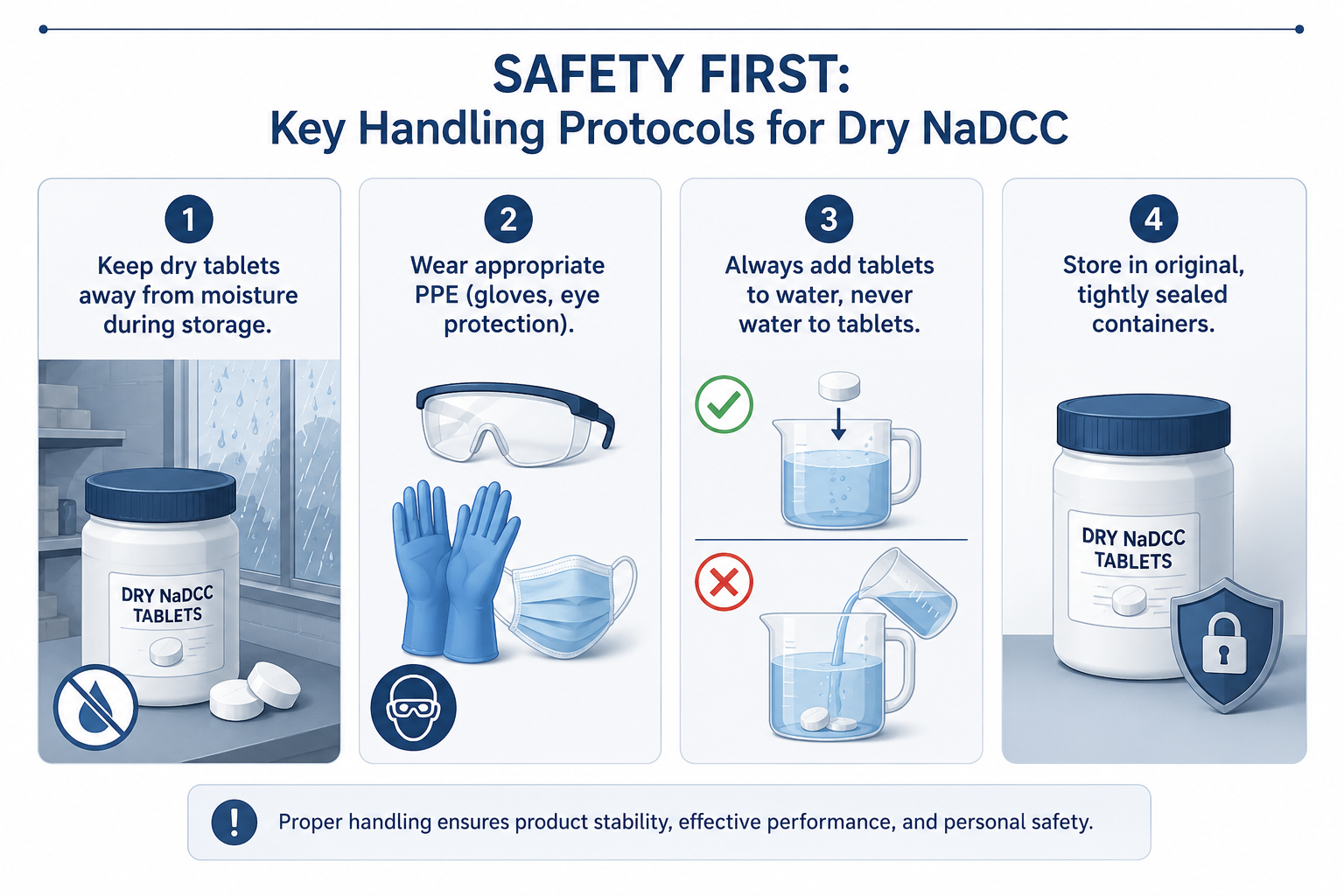
-
Storage and Environmental Control: Keep your stock in its original, sealed packaging. Put them in a cool, dry spot away from sunlight, acids, and flammable materials. If moisture creeps into a sealed tub of dry tablets, it triggers a slow breakdown that releases toxic chlorine gas and warps the container.
-
Personal Protective Equipment (PPE): Wear safety goggles and nitrile or neoprene gloves whenever you handle raw tablets or mix concentrated batches. If a tablet gets crushed and throws up dust, staff must wear a particulate respirator to protect their lungs.
-
Preparation Safety (The "Water-First" Rule): This is critical. Staff must drop the tablet into the water, rather than splashing water onto dry tablets. Doing this backward causes a sudden, intense chemical reaction that spits out nasty chlorine gas.
-
Ventilation Requirements: Mixing heavy-duty batches, like the 5,000 ppm solutions used to fight tough spores, requires good airflow. Standard building ventilation or an open window will keep chlorine odors from building up in the room.
-
Disposal and Environmental Compliance: Used solutions that have finished their cleaning cycle are safe to pour down standard drains. For leftover, highly concentrated mixtures, you must neutralize them with sodium thiosulfate first or call in a licensed waste contractor.
Using a standardized setup like TXDY PRO SolvTab CARE alongside these rules keeps your team safe. You will stop worrying about splashing liquids, shrink your storage footprint, and run a tight, compliant operation.
Frequently asked questions
What are NaDCC disinfectant tablets made of?
NaDCC tablets are made by blending anhydrous sodium dichloroisocyanurate (also known as sodium troclosene)—a dry, organic chlorine donor—with acidic and alkaline effervescing agents, specifically adipic acid and sodium bicarbonate.
How do NaDCC tablets work once dissolved in water?
When dissolved in water, the tablet's effervescing agents cause it to fizz and dissolve almost instantly. This rapid dissolution establishes a dynamic chemical equilibrium that releases free available chlorine (FAC), flooding the solution with active hypochlorous acid (HOCl) which easily penetrates microbial cell membranes.
How are NaDCC tablets different from bleach or sodium hypochlorite?
Unlike liquid sodium hypochlorite, which is highly alkaline (pH 11.0 to 13.0) and degrades rapidly in storage, NaDCC is a stable, dry organic chlorine donor. When dissolved, NaDCC buffers the water to a near-neutral pH (5.5 to 6.5), keeping over 90% of the chlorine in the active biocidal form (HOCl), compared to less than 10% in liquid bleach.
What are NaDCC tablets used for: surfaces, healthcare, or water treatment?
NaDCC tablets are used by facility and hygiene managers across healthcare, food processing, industrial, and agricultural sectors to disinfect equipment, surfaces, and high-traffic areas. They offer an alternative to traditional liquid bleach for institutional, commercial, and operational hygiene programs.
What pathogens or spores can NaDCC tablet solutions kill, and at what strength and contact time?
NaDCC tablet solutions release hypochlorous acid (HOCl) to neutralize pathogens. Because HOCl has a neutral charge, it easily penetrates microbial outer membranes to destroy internal proteins, enzymes, and nucleic acids. Enveloped viruses typically fall at 100–500 ppm within a minute, while tough bacterial spores such as C. difficile require 4,000–5,000 ppm with 4 to 10 minutes of wet contact time.
What dilution or dosage is needed to achieve a target ppm chlorine solution?
To achieve highly accurate, predictable dosing, pre-measured NaDCC dry tablets are dissolved in water. Unlike liquid bleach, which requires complex manual calculations and strip testing due to constant product decay, NaDCC tablets provide high-precision dosing because each pre-measured solid unit delivers a consistent, known concentration of active chlorine.
Are NaDCC tablets safer, less corrosive, or easier to handle than bleach?
Yes. NaDCC tablets are dry, low-weight, and compact, making them safer and easier to store and ship than bulky, heavy hazardous liquid bleach. Furthermore, because NaDCC solutions hover at a near-neutral pH (5.5 to 6.5) instead of the highly alkaline pH of bleach, they are only mildly corrosive and highly compatible with synthetic floors and metals.
What is the 'reservoir effect' of NaDCC in disinfection?
The reservoir effect is a chemical process of reversible hydrolysis where only about half of the chlorine in the dissolved NaDCC solution exists as free active chlorine (HOCl) at any given moment. The remaining half is temporarily bound. As active HOCl is depleted by organic dirt or pathogens, the chemical balance shifts to release more HOCl, extending the solution's lifespan and reducing harsh fumes.
Ready to standardise your disinfection protocol?
Talk to our team about implementing PRO SolvTab™ CARE across your operation.
Related articles
Why Controlled-Dose Disinfectant Tablets Improve Hygiene Consistency
How Standardised Disinfectant Preparation Reduces Human Error Across Healthcare and Food Operations
What is Disinfection?
A Practical Guide to Understanding Disinfection and Why It Matters in Real-World Hygiene
What is Hygiene?
Understanding the Foundation of Health, Safety, and Infection Prevention