
NaDCC vs Sodium Hypochlorite
Understanding the Real Differences Between Two Widely Used Chlorine Disinfectants
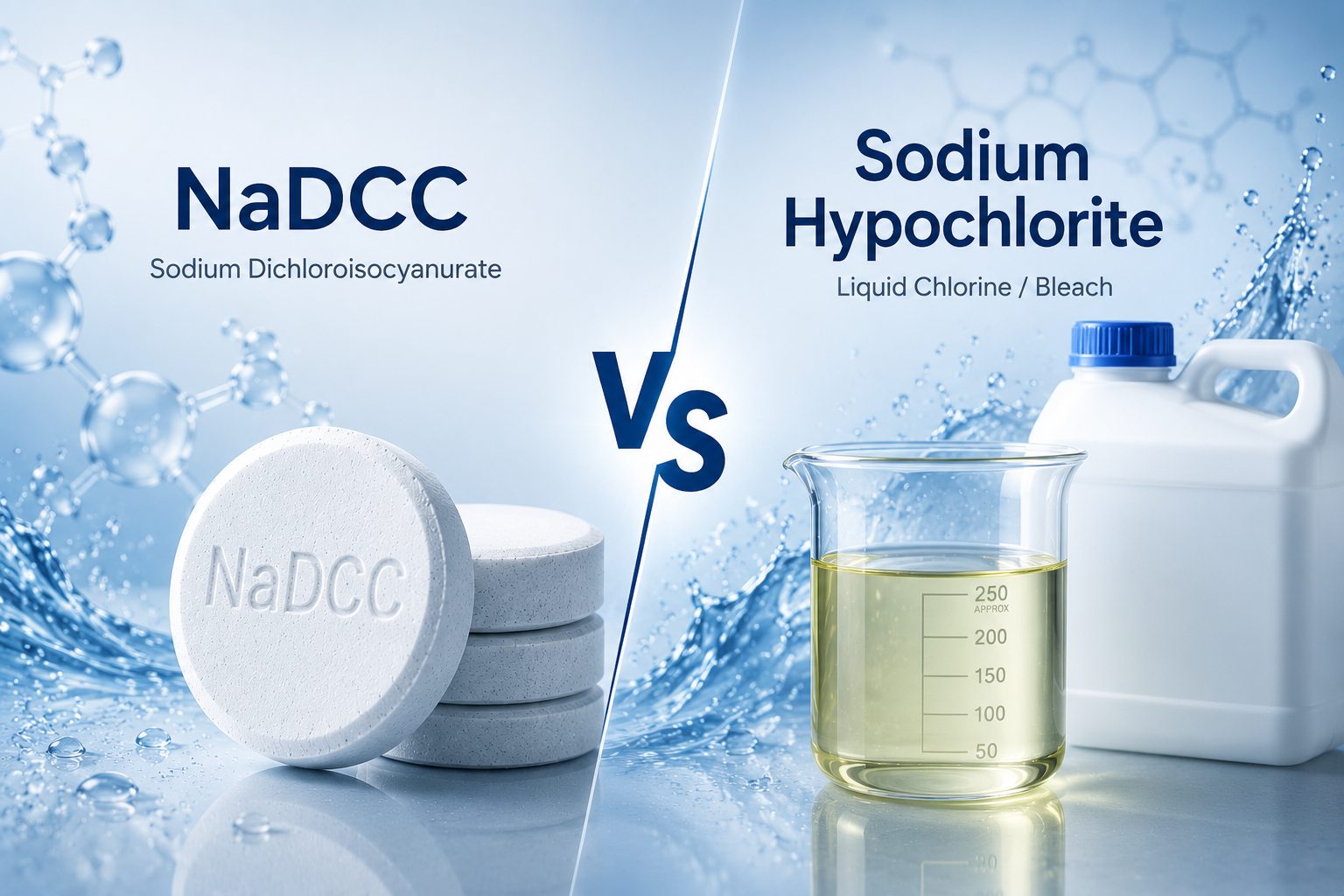
NaDCC vs Sodium Hypochlorite: Which One Should You Choose?
Few questions generate more confusion in professional hygiene than this:
"Is NaDCC better than sodium hypochlorite?"
It's a reasonable question—but it's also the wrong one.
After spending years working with hospitals, clinics, food manufacturers, facility managers, and distributors, I've learned that organisations often compare these products as if they're competing disinfectants.
They're not.
They're two different ways of delivering chlorine disinfection.
The chemistry matters, but operational realities matter just as much.
I've seen hospitals achieve excellent infection prevention programmes using sodium hypochlorite. I've also seen hospitals struggle with it—not because the chemistry failed, but because preparation became inconsistent across shifts.
Likewise, I've seen organisations successfully standardise their disinfection programme using NaDCC tablets because the product format better suited the way their teams actually worked.
The better question is:
Which disinfectant delivery system best supports your operational environment?
Once organisations start asking that question instead, choosing between NaDCC and sodium hypochlorite becomes much clearer.
What Is NaDCC?
NaDCC (Sodium Dichloroisocyanurate) is a chlorine-releasing compound commonly supplied as tablets or granules.
When dissolved in water, it releases hypochlorous acid (HOCl), the active disinfecting agent responsible for inactivating a broad range of bacteria, viruses, fungi, and other microorganisms.
Rather than being supplied as a ready-made liquid, NaDCC is prepared by dissolving a measured quantity into water immediately before use.
Its greatest operational strength lies in controlled dosing and preparation consistency.
What Is Sodium Hypochlorite?
Sodium hypochlorite is the active ingredient found in liquid bleach.
It is supplied as a liquid concentrate that must usually be diluted before use to achieve the desired available chlorine concentration.
Like NaDCC, sodium hypochlorite also produces hypochlorous acid when diluted appropriately.
From a microbiological perspective, both disinfectants ultimately rely on the same active chlorine species to destroy microorganisms.
The difference is not primarily how they disinfect.
The difference is how they are prepared, stored, transported, and managed.
The Biggest Difference Isn't the Chemistry
Many people expect one disinfectant to be significantly stronger than the other.
That's rarely the deciding factor.
In professional environments, the biggest difference is usually operational consistency.
Imagine a hospital preparing disinfectant three times a day.
With liquid concentrate, staff must measure the correct amount of product, calculate the appropriate dilution, and ensure the correct volume of water is used.
Every manual step creates another opportunity for inconsistency.
Now imagine the same hospital using controlled-dose tablets.
Preparation becomes much simpler.
Instead of measuring concentrate, staff dissolve the specified number of tablets into the correct volume of water.
The chemistry hasn't fundamentally changed.
The preparation process has.
That difference can significantly improve consistency across departments, shifts, and facilities.
Storage and Shelf Life
One issue that procurement teams often overlook is storage stability.
Liquid sodium hypochlorite gradually loses available chlorine over time, particularly when exposed to heat, sunlight, or unsuitable storage conditions. This means stock rotation, storage temperatures, and expiry management become important considerations.
NaDCC tablets, by contrast, are generally more stable in their dry form when stored according to the manufacturer's recommendations.
This can simplify warehousing, especially in organisations that maintain emergency stock or distribute products across multiple locations.
For facilities with limited storage space or regional distribution networks, that stability becomes a practical operational advantage.
Ease of Training
One of the hidden costs in healthcare isn't purchasing disinfectant. It's training staff.
Every year, hospitals onboard new cleaners, nurses, support staff, contractors, and temporary personnel.
The easier a system is to teach, the more consistently it tends to be followed.
Liquid concentrates often require explaining:
-
Dilution ratios
-
Measuring cylinders
-
Mixing calculations
-
Different bottle strengths
-
Water volumes
For experienced staff, this isn't particularly difficult.
For new employees working under pressure, mistakes become more likely. Tablet systems simplify the process considerably.
Instead of teaching mathematical calculations, training focuses on following clear preparation instructions.
That reduction in complexity can improve consistency without compromising effectiveness.
Transport and Logistics
This is something few end users think about.
Water is heavy.
Liquid disinfectants are largely water.
Transporting large volumes of liquid means higher freight weight, more warehouse space, and more storage capacity.
NaDCC tablets remove much of that unnecessary weight.
Thousands of litres of disinfectant solution can be prepared from a relatively compact quantity of tablets.
For organisations operating multiple hospitals, satellite clinics, or regional distribution centres, this improves logistics and reduces handling requirements.
Which Product Is More Suitable for Healthcare?
There's no universal answer.
It depends on how the organisation operates.
Healthcare facilities often choose NaDCC because it supports:
-
Controlled dosing
-
Standardised preparation
-
Simplified staff training
-
Compact storage
-
Easier internal distribution
-
More predictable inventory management
That doesn't mean sodium hypochlorite is unsuitable.
Many healthcare organisations continue to use it successfully.
The deciding factor is whether the existing preparation process can consistently produce the correct disinfectant concentration every time.
If it can, either system may perform well.
If variability is becoming a challenge, tablet-based systems may provide a practical solution.
Common Misconceptions - "NaDCC Is Stronger Than Sodium Hypochlorite"
Not necessarily.
Both disinfectants generate hypochlorous acid, which is the active antimicrobial agent responsible for disinfection.
Effectiveness depends on preparing the correct available chlorine concentration and allowing sufficient contact time—not simply on the product name.
"Liquid Bleach Is Always Cheaper"
The purchase price tells only part of the story.
Organisations should also consider:
-
Product wastage
-
Overdosing
-
Staff training
-
Storage requirements
-
Transport costs
-
Inventory management
-
Preparation errors
A lower purchase price doesn't always translate into a lower overall operating cost.
"Tablets Eliminate Human Error"
They reduce certain types of human error, but they don't eliminate it.
Staff must still:
-
Use the correct water volume
-
Follow preparation instructions
-
Replace solutions at recommended intervals
-
Observe the required contact time
-
Store products correctly
Successful disinfection still depends on good hygiene practices and proper staff training.
Choosing the Right Solution
When evaluating chlorine disinfectants, avoid asking:
"Which chemical is better?"
Instead, ask:
-
Which preparation method best suits our staff?
-
Which system reduces variability?
-
Which product is easier to standardise across multiple sites?
-
Which fits our storage capacity?
-
Which supports our training programme?
-
Which aligns with our operational workflow?
These questions usually lead to better long-term decisions than comparing chemistry alone.
Final Thoughts
NaDCC and sodium hypochlorite are both well-established chlorine disinfectants with proven roles in professional hygiene.
From a scientific perspective, both ultimately rely on hypochlorous acid to achieve effective disinfection.
Where they differ is in how they fit into day-to-day operations.
NaDCC tablets are often chosen for their ability to simplify preparation, improve dosing consistency, and support standardised workflows. Sodium hypochlorite remains a practical and effective option where organisations already have robust dilution procedures and experienced staff.
Ultimately, the most effective disinfectant is not the one with the most familiar name or the lowest purchase price. It is the one that can be prepared correctly, used consistently, and integrated into a reliable hygiene programme every single day.
Ready to standardise your disinfection protocol?
Talk to our team about implementing PRO SolvTab™ CARE across your operation.
Related articles
Why Healthcare Environmental Cleaning Needs Both Protocols and Trained Staff
A cleaning SOP alone does not create a reliable healthcare cleaning programme. Learn why environmental hygiene depends on both clear protocols and trained personnel who can apply them consistently.
Why Hospitals Are Switching to NaDCC Disinfectant Tablets
The Operational Reasons Healthcare Facilities Are Moving Towards Controlled-Dose Chlorine Disinfection
What is NaDCC?
A Practical Guide to Sodium Dichloroisocyanurate and Why It Has Become a Trusted Healthcare Disinfectant