
Why Hospitals Are Switching to NaDCC Disinfectant Tablets
The Operational Reasons Healthcare Facilities Are Moving Towards Controlled-Dose Chlorine Disinfection
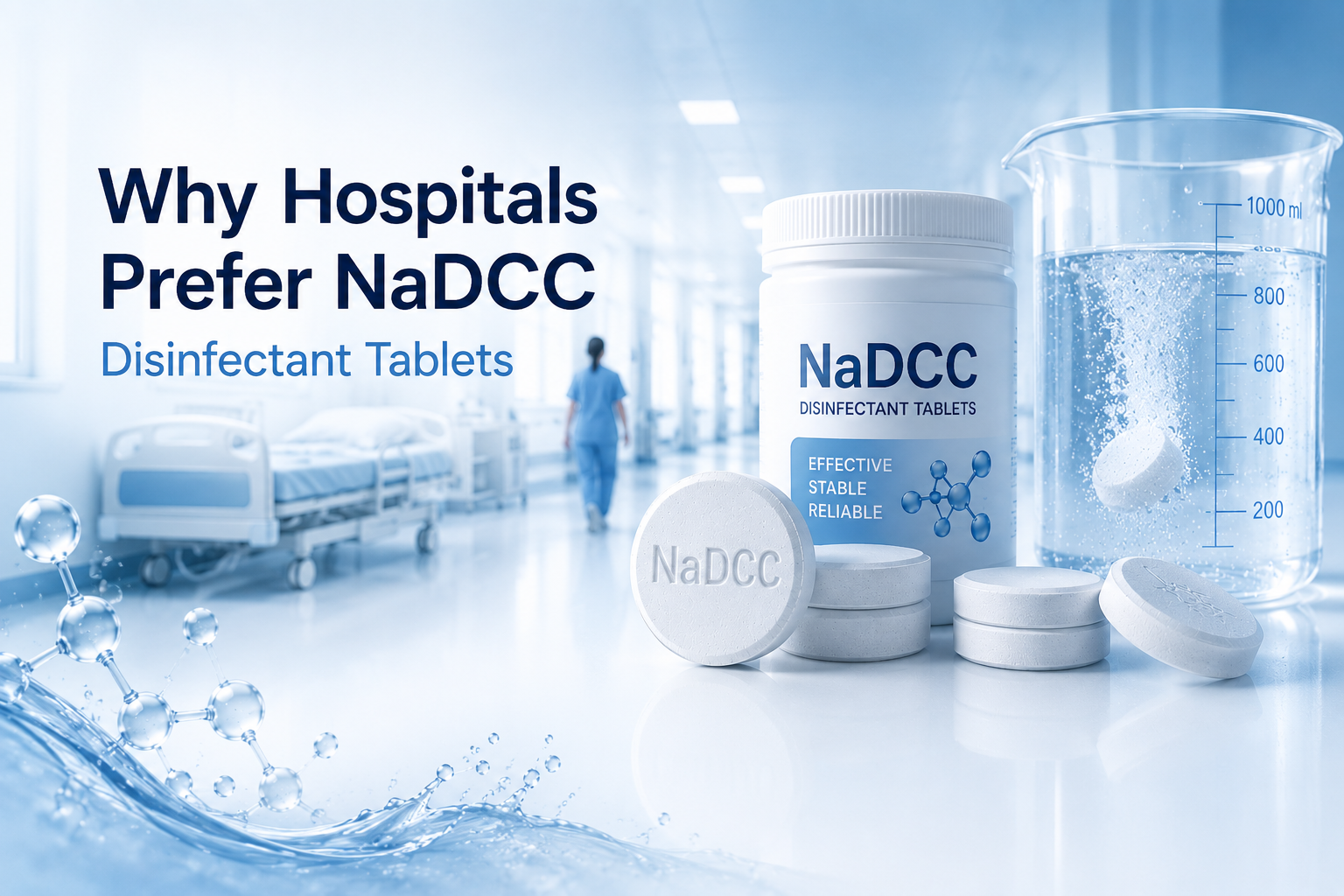
One of the biggest misconceptions outside healthcare is that hospitals simply buy the "strongest" disinfectant available.
In reality, hospital procurement teams, infection prevention specialists, and environmental services managers evaluate far more than laboratory efficacy.
A disinfectant may perform exceptionally well under controlled laboratory conditions, but if staff cannot prepare it consistently across multiple departments, shifts, and facilities, the real-world outcome becomes far less predictable.
After working with healthcare facilities for years, I've learned that hospitals rarely ask:
"Which disinfectant kills bacteria the fastest?"
Instead, they ask questions like:
-
Can every staff member prepare it correctly?
-
Will different wards produce the same concentration?
-
Is training straightforward?
-
Can procurement accurately forecast consumption?
-
Will it simplify our workflow?
-
Does it reduce operational variability?
These are the questions that have driven the growing adoption of NaDCC (Sodium Dichloroisocyanurate) disinfectant tablets in healthcare environments worldwide.
The decision isn't simply about chemistry.
It's about building a more reliable disinfection system.
Consistency Is the Real Goal
Hospitals operate on standardisation.
Medication doses are standardised.
Sterilisation cycles are standardised.
Clinical documentation is standardised.
Disinfectant preparation should follow the same principle.
Yet one of the most common causes of inconsistency in environmental cleaning isn't the disinfectant itself.
It's how the disinfectant is prepared.
When liquid concentrates are manually measured, even experienced staff can produce slightly different concentrations.
One person pours slightly more.
Another estimates the water volume.
Someone else uses a different measuring container.
Individually, these differences seem insignificant.
Across hundreds of preparations every week, they become meaningful.
NaDCC tablets help reduce that variation by providing pre-measured doses that are dissolved into a specified volume of water.
The objective isn't to remove human involvement.
It's to remove unnecessary guesswork.
Why Controlled Dosing Matters
One lesson that every infection prevention team eventually learns is this:
Consistency is often more valuable than complexity.
Healthcare staff work under constant pressure.
Emergency admissions.
Shift changes.
Unexpected staffing shortages.
High patient turnover.
In these environments, preparation systems must be simple enough to remain reliable even when workloads increase.
Controlled-dose tablets achieve this by standardising one of the most important variables:
The amount of disinfectant entering the solution.
Instead of asking staff to calculate dilution ratios from concentrated liquids, preparation becomes a straightforward process of using the correct number of tablets with the correct amount of water.
The result is greater repeatability across the organisation.
Easier Staff Training
Every hospital trains new personnel.
Housekeeping staff.
Agency cleaners.
Support services.
Temporary employees.
Contractors.
Teaching dilution calculations can be surprisingly time-consuming.
New staff must understand:
-
Product strengths
-
Dilution ratios
-
Measuring equipment
-
Water volumes
-
Different cleaning tasks
Tablet systems simplify much of this process.
Training shifts away from mathematical calculations and towards following standard operating procedures.
In my experience, simpler preparation methods generally produce more consistent outcomes because they reduce the number of opportunities for mistakes.
Reduced Risk of Preparation Errors
Healthcare facilities spend enormous effort reducing clinical errors.
The same philosophy applies to environmental hygiene.
Preparation errors can occur for many reasons:
-
Incorrect measuring equipment
-
Misread dilution charts
-
Estimating instead of measuring
-
Interrupted preparation
-
Staff unfamiliar with the product
Pre-measured tablets don't eliminate every possible mistake, but they significantly reduce one of the largest variables: manually measuring concentrated disinfectant.
This supports a more standardised preparation process across different users and departments.
Better Inventory Control
One operational benefit that's often overlooked is inventory management.
With liquid concentrates, it can be difficult to determine exactly how much disinfectant has been used.
Over-pouring isn't always obvious.
Neither is under-dosing.
Tablet systems provide a more predictable unit of consumption.
Procurement teams can estimate usage based on tablet counts rather than trying to determine how much liquid concentrate has been dispensed.
This improves forecasting, purchasing, and stock planning.
Storage Efficiency
Hospitals consume significant quantities of disinfectant every day.
Liquid products require storage space because most of their volume is water.
NaDCC tablets are different.
A relatively compact quantity of tablets can prepare thousands of litres of disinfectant solution when required.
This creates practical advantages:
-
Less warehouse space
-
Easier internal distribution
-
Reduced storage at nursing stations
-
Improved emergency stock management
For facilities where storage is already limited, these operational efficiencies matter.
Easier Distribution Across Multiple Departments
Hospitals are not single buildings with one cleaning cupboard.
Disinfectant may be needed in:
-
Emergency departments
-
Intensive care units
-
General wards
-
Outpatient clinics
-
Laboratories
-
Operating theatre support areas
-
Isolation rooms
-
Ambulances
Instead of transporting large quantities of ready-made liquid disinfectant throughout the facility, tablet systems allow departments to prepare fresh solutions closer to where they are used.
This reduces handling while improving flexibility.
Supporting Standardised Infection Prevention
Infection prevention isn't achieved by purchasing good products.
It's achieved by ensuring those products are used consistently.
The best hospital hygiene programmes focus on reducing unnecessary variation.
Everyone follows the same procedures.
Everyone prepares the same concentrations.
Everyone understands the same protocols.
NaDCC tablets support this philosophy because they make standardisation easier to implement across large organisations.
Common Misconceptions - "Hospitals Use Tablets Because They're Stronger"
No.
Hospitals don't choose tablets because they contain more chlorine.
They choose them because they simplify consistent preparation.
The effectiveness of chlorine disinfection still depends on achieving the correct concentration and allowing the appropriate contact time.
"Tablets Replace Good Training"
Absolutely not.
Even the best disinfectant system requires:
-
Staff education
-
Standard operating procedures
-
Proper storage
-
Correct water volumes
-
Routine supervision
-
Quality assurance
Tablet systems support training.
They don't replace it.
"One Tablet Fits Every Application"
Different healthcare tasks require different available chlorine concentrations.
Cleaning a routine environmental surface is not the same as responding to a blood spill.
Healthcare facilities should always follow their infection prevention policies and manufacturer instructions when selecting dilution concentrations.
Are Tablets Right for Every Hospital?
Not necessarily.
Some hospitals already have highly effective liquid dilution systems supported by automated dosing equipment and experienced environmental services teams.
For these organisations, existing workflows may already provide excellent consistency.
However, many healthcare facilities continue to prepare disinfectants manually.
In those environments, controlled-dose tablets often provide meaningful operational benefits by simplifying preparation and reducing variability.
The best solution is the one that aligns with the organisation's workflow, staffing, infrastructure, and infection prevention programme.
Looking Beyond Product Cost
One of the biggest procurement mistakes is evaluating disinfectants using purchase price alone.
Experienced healthcare buyers look at total operational value.
Questions include:
-
How long does staff training take?
-
How much product is wasted?
-
How often are dilution mistakes made?
-
How much warehouse space is required?
-
Is inventory easy to manage?
-
How reliable is supply?
These operational factors often have a greater long-term impact than the unit price of the disinfectant itself.
Final Thoughts
Hospitals don't choose NaDCC disinfectant tablets because they're looking for a different form of chlorine.
They choose them because healthcare demands consistency.
Every day, hundreds of staff members prepare disinfectants across multiple departments, often under significant time pressure.
The easier that process is to standardise, the easier it becomes to maintain reliable infection prevention practices.
NaDCC tablets don't replace good training, strong cleaning protocols, or effective supervision.
What they do provide is a practical way to simplify one of the most important parts of any hygiene programme: preparing the right disinfectant concentration, consistently, every single time.
In healthcare, that consistency isn't just operational efficiency.
It's an important part of protecting patients, healthcare workers, and the environments where care is delivered.
Ready to standardise your disinfection protocol?
Talk to our team about implementing PRO SolvTab™ CARE across your operation.
Related articles
Why Healthcare Environmental Cleaning Needs Both Protocols and Trained Staff
A cleaning SOP alone does not create a reliable healthcare cleaning programme. Learn why environmental hygiene depends on both clear protocols and trained personnel who can apply them consistently.
NaDCC vs Sodium Hypochlorite
Understanding the Real Differences Between Two Widely Used Chlorine Disinfectants
What is NaDCC?
A Practical Guide to Sodium Dichloroisocyanurate and Why It Has Become a Trusted Healthcare Disinfectant