
What is NaDCC?
A Practical Guide to Sodium Dichloroisocyanurate and Why It Has Become a Trusted Healthcare Disinfectant
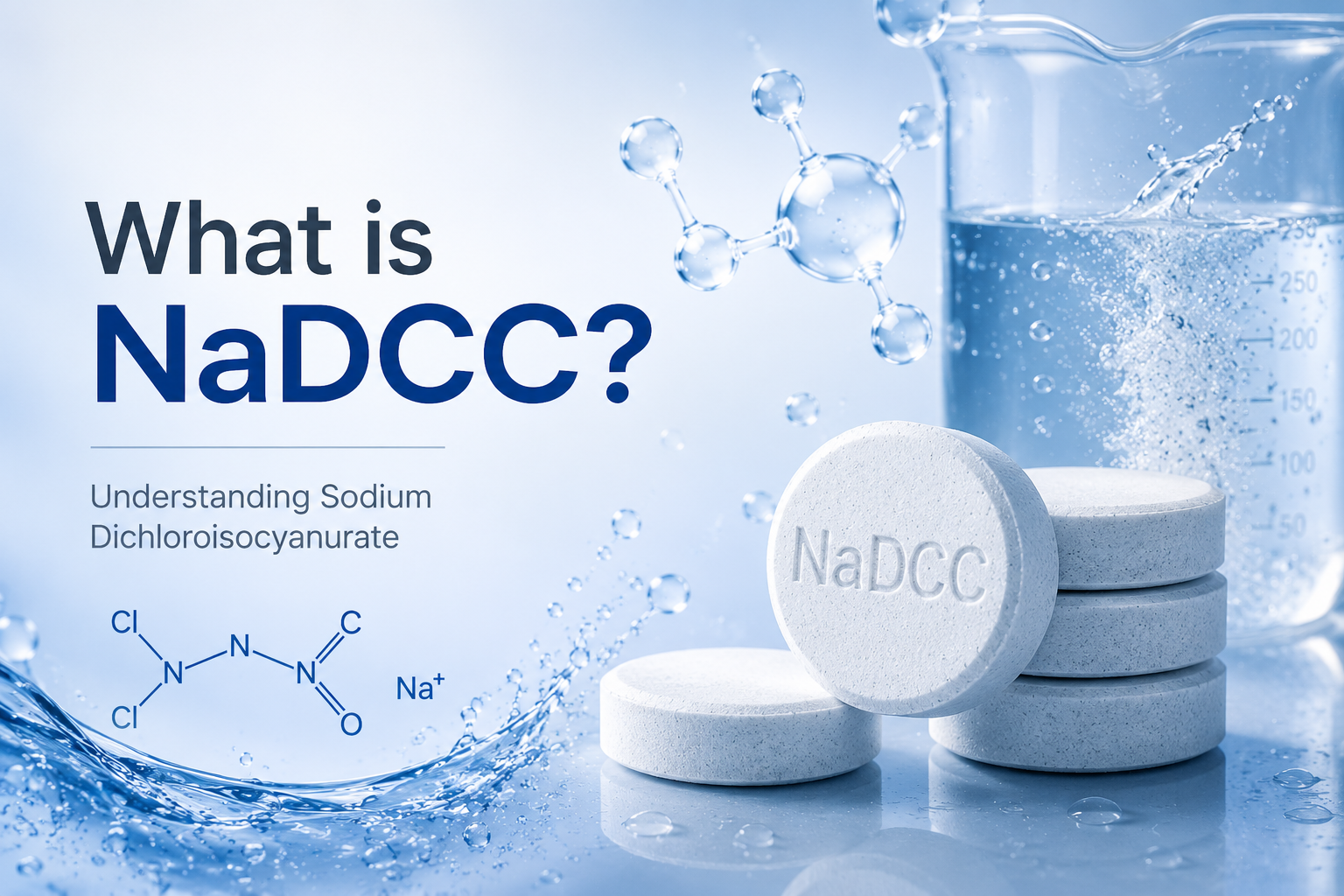
What is NaDCC?
If you've ever worked in a hospital, aged care facility, laboratory, or food processing plant, you've almost certainly encountered chlorine disinfectants. Yet one of the most widely used chlorine technologies—Sodium Dichloroisocyanurate (NaDCC)—remains surprisingly misunderstood.
Ask ten people what NaDCC is, and you'll often hear the same response:
"It's just another chlorine tablet."
Technically, that's true.
Practically, it's a huge oversimplification.
After years of working with healthcare facilities and hygiene operations, one thing becomes clear: organisations don't choose NaDCC simply because it's chlorine. They choose it because it solves operational problems that liquid disinfectants often struggle to address—namely consistency, ease of preparation, storage efficiency, and standardisation.
Understanding NaDCC isn't just about chemistry. It's about understanding why hospitals, clinics, nursing homes, laboratories, and many other professional environments rely on it to support safe and repeatable disinfection practices.
What Does NaDCC Stand For?
NaDCC stands for Sodium Dichloroisocyanurate, a chlorine-releasing compound used to prepare disinfectant solutions.
When dissolved in water, NaDCC releases hypochlorous acid (HOCl), the active antimicrobial agent responsible for destroying many bacteria, viruses, fungi, and other microorganisms.
Although the chemical name sounds complex, its purpose is straightforward:
To provide a reliable source of available chlorine for professional disinfection.
Today, NaDCC is used worldwide across healthcare, food production, agriculture, emergency response, water treatment, and institutional cleaning because it offers a practical way to prepare chlorine disinfectant solutions with consistent concentrations.
How Does NaDCC Work?
One of the most common misconceptions is that the tablet itself performs the disinfection.
It doesn't.
The tablet is simply the delivery system.
Once dissolved in water, NaDCC undergoes a chemical reaction that produces hypochlorous acid (HOCl). This is the active disinfecting agent that attacks microorganisms by disrupting essential cellular functions, damaging proteins, and interfering with metabolic processes. The result is the rapid inactivation of many harmful pathogens when used at the correct concentration and contact time.
In other words, NaDCC tablets are designed to make the delivery of effective chlorine disinfection more controlled and repeatable—not to change the underlying science of chlorine.
Why Isn't Everyone Using Liquid Bleach Instead?
This is one of the questions I hear most often.
On paper, liquid sodium hypochlorite and NaDCC can both provide chlorine-based disinfection.
In practice, the difference lies in how consistently they can be prepared and managed.
Think about a typical housekeeping room in a busy hospital.
One staff member starts at 7:00 a.m.
Another begins at 3:00 p.m.
A third works overnight.
Each person prepares disinfectant for the same hospital.
If all three manually measure liquid concentrate, even small differences in pouring technique, measuring containers, or water volume can produce different chlorine concentrations.
No one intends to prepare the solution incorrectly. Yet over hundreds of preparations, small inconsistencies become inevitable.
NaDCC tablets help simplify this process.
Instead of estimating liquid volumes, staff simply dissolve a specified number of tablets into a known amount of water. The process becomes easier to teach, easier to repeat, and easier to standardise across departments and shifts.
For healthcare organisations, that operational consistency is often just as valuable as the disinfectant itself.
Why Has NaDCC Become So Popular in Healthcare?
Hospitals don't evaluate disinfectants based only on laboratory performance.
They also consider how the product fits into daily operations.
Over the years, I've found that infection prevention teams ask practical questions such as:
-
Can staff prepare it correctly every time?
-
Is training straightforward?
-
Will different departments produce the same solution?
-
Is it easy to transport between sites?
-
Can procurement forecast usage accurately?
-
Does it simplify stock storage?
These operational considerations are where NaDCC tablets offer significant advantages.
Because the dosage is pre-measured during manufacturing, preparation becomes far less dependent on manual judgement.
This helps reduce variability while supporting more consistent hygiene practices across healthcare facilities.
The Biggest Advantage Isn't Chemistry—It's Consistency
Many people assume NaDCC became popular because it's a stronger disinfectant.
That's not quite accurate.
Its greatest advantage is that it helps organisations achieve consistent preparation.
In infection prevention, consistency matters.
A disinfectant prepared at the wrong concentration may not perform as intended.
Preparing it stronger than necessary doesn't automatically improve results either. It may increase chemical consumption, affect material compatibility, and create unnecessary operational costs.
The goal is not "more chlorine."
The goal is the correct chlorine concentration, prepared consistently every time.
That simple distinction is one of the biggest lessons many organisations learn after moving from manually measured liquid concentrates to controlled-dose tablet systems.
Where Is NaDCC Commonly Used?
Because NaDCC is versatile, it can be found across a wide range of professional environments.
Common applications include:
Healthcare
-
Hospitals
-
Clinics
-
Dental practices
-
Aged care facilities
-
Laboratories
-
Ambulances
Food Industry
-
Food processing plants
-
Commercial kitchens
-
Catering facilities
-
Slaughterhouses
Agriculture
-
Poultry farms
-
Livestock operations
-
Veterinary clinics
-
Aquaculture facilities
Commercial & Institutional
-
Schools
-
Universities
-
Hotels
-
Office buildings
-
Facility management operations
Each setting has different hygiene risks and therefore may require different chlorine concentrations, preparation methods, and contact times. Following the manufacturer's instructions and local infection control guidance is essential.
Common Misunderstandings About NaDCC
After working with end users for years, a few misconceptions appear repeatedly.
"NaDCC Is Just Bleach"
Not exactly.
Both NaDCC and sodium hypochlorite are chlorine-based disinfectants, but they are different chemical compounds and are supplied in different forms. NaDCC is commonly available as tablets or granules, making it particularly suitable where controlled dosing and portability are important.
"One Tablet Works for Everything"
Not true.
The same tablet can produce different chlorine concentrations depending on how much water it is dissolved in.
Using one tablet in 150 mL of water creates a much stronger solution than dissolving the same tablet in 10 litres.
Understanding dilution is just as important as selecting the disinfectant itself.
"Stronger Means Better"
This is perhaps the most expensive misconception.
Using a higher chlorine concentration than required does not automatically provide better disinfection.
Instead, organisations should use the concentration appropriate for the specific application, balancing effectiveness, safety, material compatibility, and operational efficiency.
Evidence-based disinfection is about using the right concentration, not simply the highest one.
Choosing the Right NaDCC Product
Not all NaDCC products are the same.
When selecting a solution, organisations should consider more than the active ingredient alone.
Key factors include:
-
Accurate tablet manufacturing
-
Reliable chlorine release
-
Clear dilution guidance
-
Appropriate packaging for operational use
-
Product traceability
-
Regulatory compliance
-
Reliable supply
-
Technical support and training
The product should fit not only the chemistry required but also the day-to-day realities of how staff prepare and use disinfectant.
Final Thoughts
NaDCC has earned its place in healthcare and other professional environments not because it reinvented chlorine disinfection, but because it made consistent chlorine preparation easier to achieve.
In environments where multiple teams, multiple shifts, and multiple sites must all produce the same disinfectant solution, reducing variation is a meaningful operational improvement.
Ultimately, effective infection prevention depends on more than selecting the right chemistry. It depends on ensuring that the right chemistry is prepared correctly, used consistently, and integrated into a well-managed hygiene programme.
That is why NaDCC continues to be trusted around the world—not simply as a disinfectant tablet, but as a practical tool for delivering more reliable hygiene outcomes.
Ready to standardise your disinfection protocol?
Talk to our team about implementing PRO SolvTab™ CARE across your operation.
Related articles
Why Healthcare Environmental Cleaning Needs Both Protocols and Trained Staff
A cleaning SOP alone does not create a reliable healthcare cleaning programme. Learn why environmental hygiene depends on both clear protocols and trained personnel who can apply them consistently.
Why Hospitals Are Switching to NaDCC Disinfectant Tablets
The Operational Reasons Healthcare Facilities Are Moving Towards Controlled-Dose Chlorine Disinfection
NaDCC vs Sodium Hypochlorite
Understanding the Real Differences Between Two Widely Used Chlorine Disinfectants