
Disinfectant Tablet Dilution: How to Calculate the Right Concentration
A Practical Guide to PPM, Water Volume, and Accurate Disinfectant Preparation
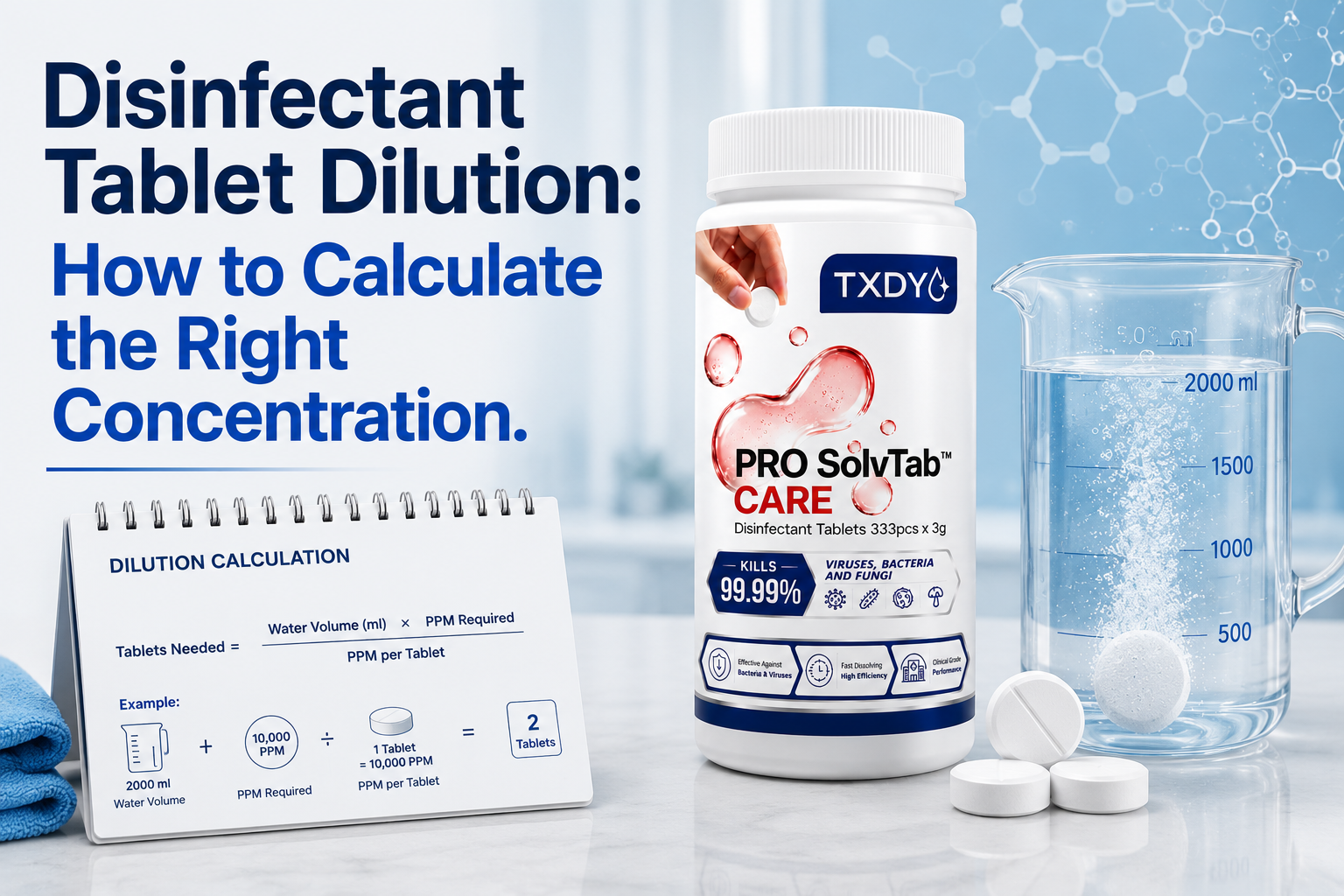
Disinfectant Tablet Dilution: How to Calculate the Right Concentration
One of the most common questions I hear when working with disinfectant tablets is:
"How many tablets do I need?"
It sounds like a simple question.
But the correct answer depends on three things:
The strength of the tablet. The target concentration. And the volume of water.
Change any one of those variables and the number of tablets required may change.
After years of working with professional hygiene operations, I've found that dilution is one of the most underestimated parts of disinfection.
Organisations can spend significant time selecting the right disinfectant, developing cleaning procedures, and training employees—only to lose consistency at the final step because the disinfectant isn't prepared correctly.
The chemistry may be right.
The product may be right.
But if the dilution is wrong, the final solution may not deliver the concentration you intended.
That's why understanding disinfectant tablet dilution is fundamental to any professional disinfection programme.
What Does Disinfectant Dilution Mean?
Dilution is the process of preparing a disinfectant solution at a specific concentration by combining a measured amount of disinfectant with a defined volume of water.
For chlorine-releasing disinfectant tablets, the target concentration is commonly expressed in parts per million (PPM) of available chlorine.
For example, a hygiene procedure may specify a target concentration such as:
-
150 ppm
-
1,000 ppm
-
2,500 ppm
-
5,000 ppm
-
10,000 ppm
The appropriate concentration depends on the intended application, the manufacturer's instructions, applicable guidelines, and the organisation's hygiene or infection prevention procedures.
This is an important distinction.
There is no single "correct PPM" for every disinfection task.
The correct concentration is the one appropriate for the specific application.
Why Proper Dilution Matters
I've seen two opposite approaches to disinfectant preparation.
The first is under-dilution, where insufficient disinfectant is used.
The second is overdosing, where staff deliberately add more product because they believe a stronger solution must provide better disinfection.
Neither approach is good practice.
Professional disinfection isn't about using as much chemical as possible.
It's about achieving the correct target concentration consistently.
When a Solution Is Too Weak
If too few tablets are used or too much water is added, the resulting solution may contain less available chlorine than intended.
This can occur when:
-
Water volumes are estimated
-
Incorrect containers are used
-
Tablet strengths are confused
-
Dilution charts are misread
-
Staff rely on memory
The danger is that the solution still looks exactly the same.
You can't determine disinfectant concentration simply by looking at the water.
That's why proper preparation procedures matter.
When a Solution Is Too Strong
The opposite mistake is assuming:
"If one tablet works, two must work better."
Not necessarily.
Using more disinfectant than required may:
-
Increase chemical consumption
-
Increase operating costs
-
Affect material compatibility
-
Increase chlorine odour
-
Create unnecessary exposure
-
Damage certain surfaces over repeated use
The objective should always be the appropriate concentration for the intended task, not the highest concentration available.
How to Calculate Disinfectant Tablet Dilution
At its simplest, disinfectant tablet dilution depends on three variables:
Tablet strength + Water volume = Target concentration
If a manufacturer's dilution chart states that:
1 tablet + 1 litre of water = X ppm
Then changing the amount of water changes the resulting concentration.
Likewise, if you need to prepare a larger volume of solution at the same PPM, the number of tablets must increase proportionally.
For example, imagine a hypothetical tablet where:
1 tablet in 1 litre of water produces 1,000 ppm.
If you wanted to prepare:
-
1 litre → 1 tablet
-
2 litres → 2 tablets
-
5 litres → 5 tablets
-
10 litres → 10 tablets
The ratio remains consistent.
However, real-world calculations become more complicated when facilities use unusual water volumes.
You may need:
-
600 mL
-
2.5 litres
-
7 litres
-
15 litres
This is where calculation errors often occur.
A Simple Dilution Formula
If you already know how much water one tablet treats at your target PPM, you can calculate the number of tablets required using:
Number of Tablets = Desired Water Volume ÷ Water Volume Treated by One Tablet
For example:
If one tablet is specified for 5 litres of water at your required concentration, and you need to prepare 20 litres:
20 ÷ 5 = 4 tablets
The calculation itself isn't difficult.
The challenge is ensuring that staff know:
-
Which tablet strength they're using
-
Which PPM they're trying to achieve
-
How much water they're preparing
This becomes particularly important when the same organisation uses multiple tablet sizes or prepares several concentrations for different hygiene applications.
Always verify the final preparation against the manufacturer's official dilution instructions.
What Happens When the Calculation Doesn't Produce a Whole Tablet?
This is where tablet dilution becomes more operationally interesting.
Imagine your calculation indicates that you need 3.5 tablets.
Can the tablet be divided?
What if the calculation requires 3.3 tablets?
Should you round down?
Round up?
Prepare a different water volume?
The answer depends on the specific product design and the manufacturer's instructions.
In professional hygiene, staff should never create their own rounding rules.
If the tablet is designed to be divided into specific increments, follow the manufacturer's approved guidance.
If it isn't, adjust the water volume or preparation method according to the product instructions.
This is one reason why clear dilution charts and digital dilution calculators can be valuable: they remove unnecessary mental calculations from day-to-day preparation.
Using a PPM Dilution Calculator
In practice, I prefer systems that reduce the number of calculations staff need to perform manually.
A good dilution calculator should allow the user to enter or select:
-
The tablet size.
-
The target PPM.
-
The amount of water required.
The calculator then determines the appropriate number of tablets based on the product's specified dilution ratios.
For users of TXDY PRO SolvTab CARE, the TXDY PPM Dilution Calculator is available on the product page:
The calculator is designed to simplify preparation by helping users determine the appropriate tablet quantity based on the selected tablet size, required PPM, and water volume.
Digital tools like this don't replace proper staff training or product instructions.
What they can do is reduce unnecessary calculation steps and make standardised preparation easier across different users and locations.
Common Dilution Mistakes
After years of observing hygiene operations, I've found that most dilution mistakes aren't complicated.
They're usually small shortcuts that gradually become normal practice.
1. Estimating Water Volume
A bucket that "looks like about 10 litres" isn't a measuring device.
If concentration matters, water volume matters.
Use clearly marked containers or appropriate measuring equipment.
2. Confusing Tablet Strengths
Not all disinfectant tablets contain the same amount of active ingredient.
One tablet from one product may produce a completely different concentration from another.
Never assume that "one tablet" is a universal dose.
3. Using the Same Dilution for Every Task
Different applications may require different disinfectant concentrations.
Routine environmental disinfection and higher-risk contamination scenarios may not require the same PPM.
Follow the relevant procedure for each application.
4. Rounding Tablet Quantities Without Guidance
If a calculation produces a fraction of a tablet, don't automatically round up or down.
Follow the manufacturer's instructions regarding tablet division and preparation.
5. Adding Extra Tablets "Just to Be Safe"
This is surprisingly common.
More disinfectant doesn't automatically mean better hygiene.
It usually means you've changed the concentration from the one specified in your procedure.
6. Forgetting About Contact Time
Correct dilution alone doesn't guarantee effective disinfection.
The solution must also remain in contact with the surface for the required period specified by the manufacturer or relevant protocol.
Correct concentration and correct contact time work together.
7. Relying Entirely on Memory
Even experienced employees make mistakes.
Clear dilution charts, standard operating procedures, labelled preparation containers, and digital calculators create a more reliable system than expecting staff to remember every ratio.
The Real Goal Is Consistency
When I evaluate a disinfection programme, I'm rarely interested in whether one experienced employee knows how to prepare the solution correctly.
I want to know whether everyone can prepare it correctly.
Morning shift.
Night shift.
New employee.
Experienced supervisor.
Different department.
Different facility.
That's the real test of a good dilution system.
Controlled-dose products such as TXDY PRO SolvTab CARE, supported by clear dilution guidance and tools such as the TXDY PPM Dilution Calculator, are designed to make this process easier to standardise.
The product itself is only one part of the system.
The bigger objective is ensuring that the correct concentration can be prepared reliably by the people who actually use it.
Final Thoughts
Disinfectant tablet dilution is simple in principle but surprisingly easy to get wrong in practice.
The number of tablets required depends on the tablet strength, target PPM, and volume of water being prepared.
Getting any of those variables wrong changes the final concentration.
That's why professional hygiene programmes shouldn't rely on estimation, memory, or informal preparation habits.
-
Use clear dilution instructions.
-
Measure water accurately.
-
Confirm the target concentration.
-
Train staff consistently.
-
And where appropriate, use digital tools to simplify calculations.
Because the goal of dilution isn't simply to prepare disinfectant.
It's to prepare the right concentration, for the right application, consistently every time.
Frequently Asked Questions
What does PPM mean in disinfectant dilution?
PPM stands for parts per million. In chlorine disinfection, it is commonly used to express the concentration of available chlorine in the prepared solution.
How do I calculate how many disinfectant tablets I need?
If you know how much water one tablet treats at your target concentration, divide your required water volume by the water volume treated by one tablet. Always verify the result against the manufacturer's official dilution instructions.
Should I round up the number of disinfectant tablets?
Not automatically. If the calculation produces a fraction of a tablet, follow the manufacturer's instructions regarding tablet division, rounding, or adjusting the preparation volume.
Does using more disinfectant improve disinfection?
Not necessarily. Effective disinfection depends on using the appropriate concentration and contact time for the intended application. Excessive concentrations may increase costs and create unnecessary material compatibility or exposure concerns.
Where can I calculate the dilution for TXDY PRO SolvTab CARE?
Users can access the TXDY PPM Dilution Calculator on the TXDY PRO SolvTab CARE product page to calculate tablet requirements based on tablet size, target PPM, and water volume:
Ready to standardise your disinfection protocol?
Talk to our team about implementing PRO SolvTab™ CARE across your operation.
Related articles
Can You Actually Sanitise a Used Sponge—or Is Replacing It Safer?
Can you really sanitise a used kitchen sponge? Learn why sponges harbour contamination, which sanitising methods help, and when replacement is the safer option.
When Is an Operating Theatre Safe to Reopen? A Guide to Terminal Cleaning and Environmental Verification
Reopening an operating theatre after an environmental or engineering incident requires more than cleaning alone. Learn how terminal cleaning, ventilation assessment, particle counting and environmental verification work together before clinical operations resume.
How Does ATP Testing Work?
A Practical Guide to ATP Hygiene Monitoring and Surface Cleanliness Verification