
Can You Actually Sanitise a Used Sponge—or Is Replacing It Safer?
Can you really sanitise a used kitchen sponge? Learn why sponges harbour contamination, which sanitising methods help, and when replacement is the safer option.
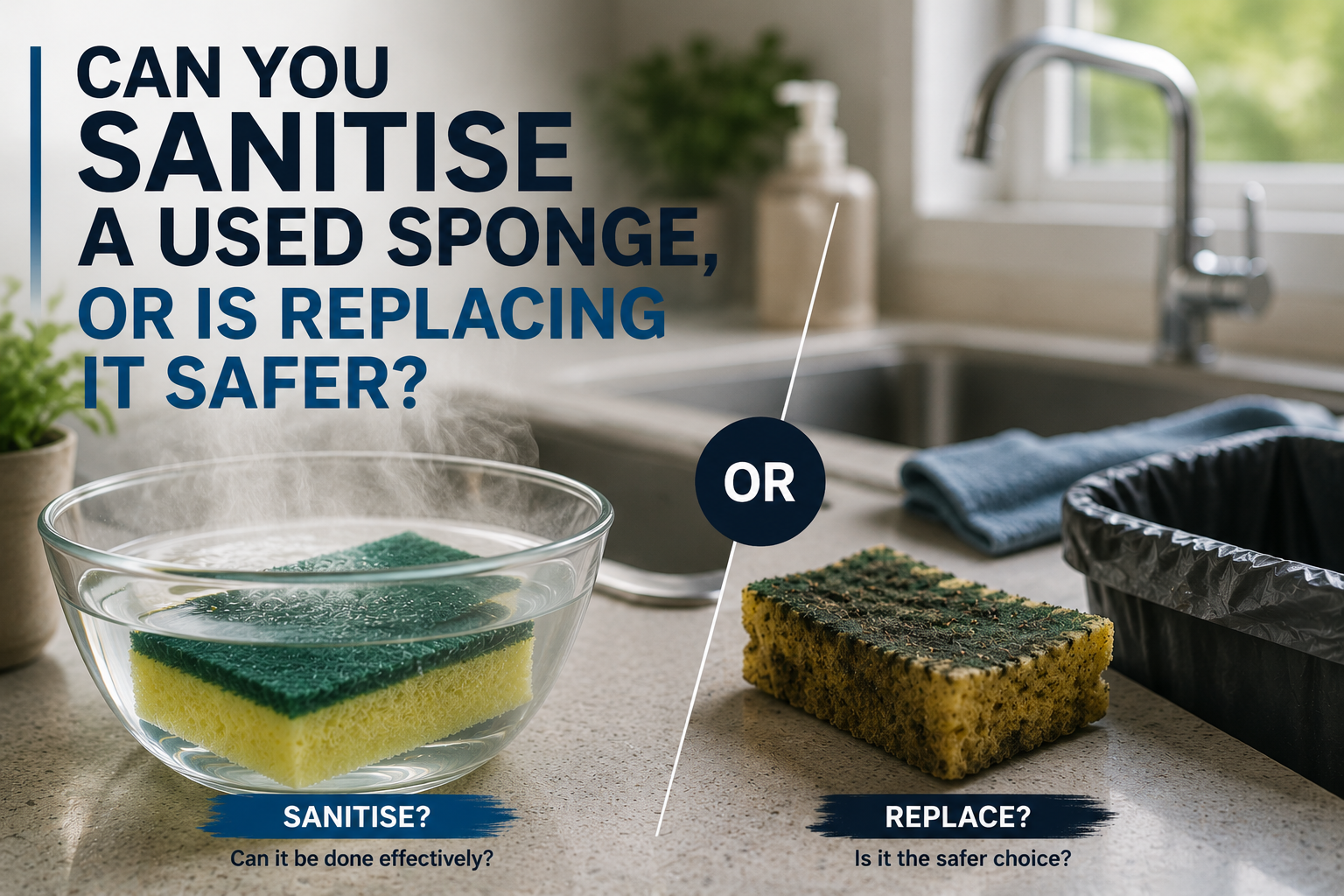
The kitchen sponge presents an interesting hygiene problem.
It is designed to remove contamination from surfaces, yet during normal use it also collects food particles, grease, moisture and microorganisms.
Then it stays wet.
Then we use it again.
This raises an obvious question:
Can you actually sanitise a used sponge effectively, or is replacing it the safer option?
The answer is more nuanced than simply putting a sponge in hot water or soaking it in disinfectant.
A sponge can be cleaned and microbial contamination can potentially be reduced using appropriate methods. However, sanitising a heavily used sponge does not restore it to a new condition, nor does it guarantee that every microorganism inside its porous structure has been eliminated.
From a hygiene perspective, the objective should therefore not be to keep a sponge indefinitely.
It should be to understand when cleaning is reasonable and when replacement is the more sensible control measure.
Why Do Kitchen Sponges Become Contaminated?
A sponge has several characteristics that make hygiene management difficult.
It frequently comes into contact with food residues and contaminated surfaces. Its porous structure can trap organic material. It is repeatedly handled, and it often remains damp between uses.
Moisture and available nutrients create conditions in which microorganisms may persist and, depending on the organism and conditions, multiply.
There is another issue that is often overlooked:
A sponge doesn't necessarily keep contamination in one place.
When the same sponge is used across chopping boards, sinks, countertops, utensils and other surfaces, contamination can potentially be transferred from one location to another.
This is known as cross-contamination.
The hygiene question is therefore not simply:
"Is my sponge dirty?"
A better question is:
"Could this sponge be transferring contamination to the next surface I clean?"
Cleaning a Sponge Is Not the Same as Sanitising It
These terms are often used interchangeably, but they describe different processes.
Cleaning primarily removes food residue, grease and other unwanted material.
Sanitising aims to reduce microorganisms to an acceptable level for the intended application.
A sponge can therefore look clean after being rinsed while still retaining microorganisms and organic residues within its structure.
This distinction matters because visible appearance is a poor indicator of microbiological cleanliness.
The same principle applies throughout professional hygiene:
Looking clean does not necessarily mean hygienically clean.
Can You Sanitise a Used Sponge?
To an extent, yes.
Appropriate treatment can reduce microbial contamination on a sponge. However, the effectiveness depends on the method used, the sponge material, its condition, the amount of organic contamination present and whether the process reaches contamination throughout the sponge.
This last point is particularly important.
A kitchen countertop is relatively straightforward to clean because it is generally a hard, accessible surface.
A sponge is different.
Its porous internal structure provides numerous spaces where moisture and organic material can remain.
This means sanitising a sponge should be viewed as a way of reducing contamination, rather than as a method of indefinitely restoring an old sponge to a hygienically new condition.
What About Hot Water?
Hot water can help with cleaning, but simply rinsing a sponge under a hot tap should not automatically be considered an effective sanitising process.
The temperature reaching the entire sponge, duration of exposure and amount of contamination all influence the result.
Hot tap water that feels uncomfortable to your hands is not necessarily equivalent to a validated thermal sanitation process.
This is a useful distinction because household hygiene advice sometimes confuses "very hot" with "microbiologically controlled."
They are not necessarily the same thing.
Can You Boil a Sponge?
Heat can reduce microorganisms when sufficient temperature and exposure time are achieved.
However, boiling is not appropriate for every sponge material. Heat may damage adhesives, synthetic materials or abrasive layers.
There is also a practical question:
If a sponge has reached the stage where it requires intensive treatment simply to remain usable, replacement may be the easier and more reliable hygiene decision.
Sanitisation should not become an excuse for extending the life of deteriorated cleaning equipment indefinitely.
Can You Microwave a Sponge?
Microwaving sponges is frequently recommended online, but this advice needs caution.
Some materials are not suitable for microwave treatment, and sponges containing metallic components or certain abrasive materials should not be placed in a microwave. There is also a risk of overheating or fire if inappropriate materials or conditions are used.
More importantly, household microwave treatment should not be interpreted as sterilisation.
Reducing microbial contamination and creating a sterile sponge are very different outcomes.
Unless the sponge manufacturer specifically states that microwave treatment is appropriate, it is better not to improvise.
What About Using Disinfectant?
Chemical disinfectants or sanitisers can reduce microorganisms when used at the correct concentration, under the correct conditions and for the required contact time.
However, a common mistake is assuming that soaking a dirty sponge in a strong disinfectant automatically solves the problem.
It may not.
Food residue and other organic matter can interfere with the performance of some disinfectants. The porous structure of the sponge can also make consistent treatment more difficult than disinfecting a hard, non-porous surface.
There may additionally be chemical residue considerations depending on the product and intended use.
For this reason, disinfectants should only be used according to their labelled instructions and intended applications.
Adding more chemical does not automatically produce a safer sponge.
When Should You Replace a Sponge Instead?
This is the part of sponge hygiene that often gets overcomplicated.
Sometimes replacement is simply the better control.
A sponge should be considered for replacement when it:
-
Develops an unpleasant or persistent odour.
-
Remains visibly soiled after cleaning.
-
Begins breaking apart or deteriorating.
-
Cannot be properly rinsed.
-
Has been used on potentially high-risk contamination.
-
Has been used for tasks that create significant cross-contamination concerns.
There is no meaningful benefit in trying to rescue a heavily contaminated, degraded sponge simply because it can technically still be used.
In professional hygiene, we often ask whether something can be cleaned.
The better question is whether cleaning it remains practical, reliable and appropriate for the risk involved.
Never Use the Same Sponge for Everything
One of the simplest ways to reduce cross-contamination is to separate cleaning tools according to their purpose.
A sponge used for washing dishes should not automatically become the sponge used for cleaning the sink, floor spills, waste areas or other potentially contaminated locations.
The same principle is used in professional cleaning through colour-coded cleaning systems.
Different cleaning tools are assigned to different areas or applications to reduce the possibility of transferring contamination between them.
You don't necessarily need a complex professional colour-coding programme in your kitchen.
But the principle is worth adopting:
Don't allow one cleaning tool to become the contamination bridge between every surface.
How to Manage Kitchen Sponges More Hygienically
Good sponge hygiene starts before sanitising becomes necessary.
Remove food residues after use and rinse the sponge thoroughly. Remove as much excess water as practical and allow it to dry rather than leaving it continuously wet in the sink.
Keep the sponge away from raw food contamination where possible, particularly raw meat juices.
Use separate cleaning tools for substantially different hygiene tasks.
And replace deteriorated or heavily contaminated sponges rather than repeatedly attempting to restore them.
These practices may sound basic, but effective hygiene is often built on simple controls performed consistently.
The Bigger Hygiene Lesson: Your Cleaning Tools Need Cleaning Too
The sponge isn't really the problem.
The broader issue is that cleaning equipment can itself become contaminated.
The same principle applies to:
-
Cleaning cloths
-
Mop heads
-
Brushes
-
Squeegees
-
Buckets
-
Reusable wipes
I've seen cleaning programmes focus extensively on which chemical should be used while paying surprisingly little attention to the condition of the equipment applying it.
A contaminated cleaning tool can undermine an otherwise well-designed hygiene process.
This is why professional hygiene programmes don't only specify what should be cleaned.
They also establish procedures for how cleaning equipment itself is cleaned, stored, separated and replaced.
So, Should You Sanitise Your Sponge or Replace It?
For a relatively new sponge in good physical condition, appropriate cleaning and sanitising practices can help manage contamination.
But sanitising should not be treated as a way of keeping a sponge indefinitely.
Once a sponge becomes heavily soiled, damaged, difficult to clean, persistently odorous or associated with higher-risk contamination, replacement is generally the more practical hygiene control.
The goal isn't to make a sponge last as long as possible.
The goal is to prevent the cleaning tool from becoming part of the contamination problem.
Final Thoughts
A kitchen sponge is a useful reminder of an important hygiene principle:
The thing doing the cleaning also needs to be managed hygienically.
Rinsing a sponge until it looks clean does not necessarily mean it is microbiologically clean. Sanitising methods may reduce contamination, but their effectiveness depends on the method, material, condition and level of contamination involved.
Rather than asking only:
"How do I sanitise my sponge?"
Ask:
"Is this sponge still an appropriate cleaning tool?"
Sometimes sanitising is reasonable.
Sometimes replacement is the better option.
Knowing the difference is what good hygiene is really about.
Frequently Asked Questions
Can you sanitise a used kitchen sponge?
Microbial contamination on a used sponge can be reduced using appropriate sanitising methods. However, sanitising does not necessarily eliminate all microorganisms or restore a heavily used sponge to its original hygienic condition.
Does rinsing a sponge with hot water sanitise it?
Not necessarily. Effective thermal sanitation depends on factors including temperature and exposure time. Briefly rinsing a sponge under hot tap water should not automatically be considered sanitisation.
Can disinfectant be used to sanitise a sponge?
Some products may be suitable for specific sanitising applications when used according to their labelled instructions. Product compatibility, concentration, contact time and any rinsing requirements must be followed.
When should a kitchen sponge be replaced?
Replacement should be considered when the sponge becomes damaged, persistently odorous, heavily contaminated, difficult to clean or unsuitable for continued hygienic use.
Can kitchen sponges cause cross-contamination?
Yes. A contaminated sponge may transfer organic material and microorganisms between surfaces during use, which is why cleaning tools should be appropriately maintained and separated according to their intended purpose.
Ready to standardise your disinfection protocol?
Talk to our team about implementing PRO SolvTab™ CARE across your operation.
Related articles
When Is an Operating Theatre Safe to Reopen? A Guide to Terminal Cleaning and Environmental Verification
Reopening an operating theatre after an environmental or engineering incident requires more than cleaning alone. Learn how terminal cleaning, ventilation assessment, particle counting and environmental verification work together before clinical operations resume.
How Does ATP Testing Work?
A Practical Guide to ATP Hygiene Monitoring and Surface Cleanliness Verification
Disinfectant Tablet Dilution: How to Calculate the Right Concentration
A Practical Guide to PPM, Water Volume, and Accurate Disinfectant Preparation