
How Does ATP Testing Work?
A Practical Guide to ATP Hygiene Monitoring and Surface Cleanliness Verification
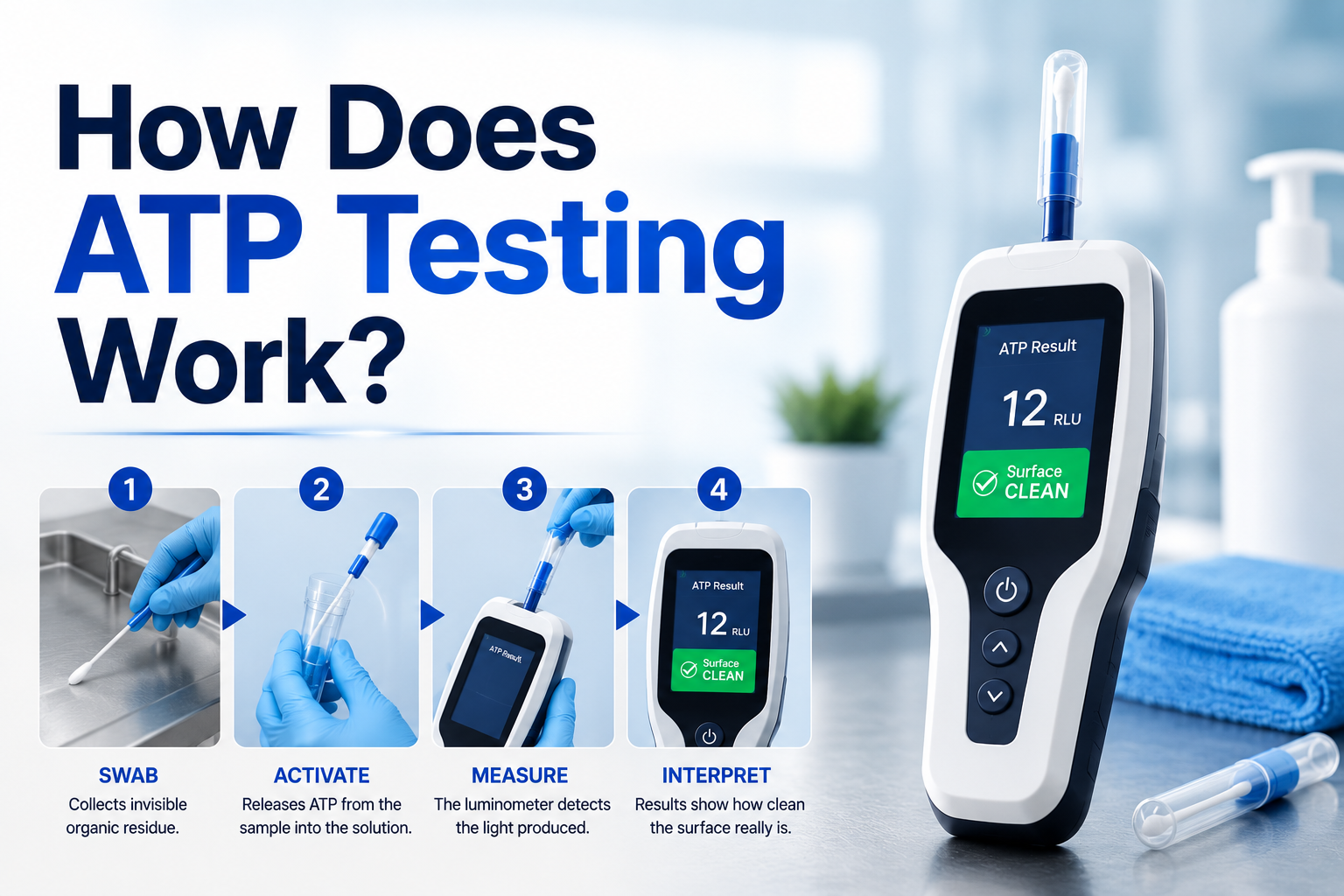
How Does ATP Testing Work?
The basic ATP testing process looks deceptively simple.
You swab a surface.
Activate the test.
Place the swab into a luminometer.
Wait a few seconds.
A number appears.
But after working with professional hygiene operations for more than a decade, I've found that the most important part of ATP testing isn't getting the number.
It's understanding what that number represents and what you should do with it.
ATP testing is commonly used as a rapid method of verifying cleaning effectiveness. It gives hygiene teams an objective measurement that can complement visual inspection and help identify areas where cleaning may not have performed as expected.
But the reliability of an ATP monitoring programme depends on much more than the technology.
Where you swab matters.
How you swab matters.
When you test matters.
How consistently different employees perform the test matters.
And most importantly, how you interpret and respond to the result matters.
To understand why, we need to look at what actually happens during an ATP test.
What Does ATP Testing Measure?
ATP stands for adenosine triphosphate, an energy-carrying molecule associated with living cells and biological material.
In hygiene monitoring, ATP may originate from sources including:
-
Food residues
-
Human biological material
-
Plant material
-
Microorganisms
-
Other organic contamination
When cleaning is performed effectively, much of this material should be removed from the surface.
If significant ATP remains after cleaning, it may indicate that organic contamination has not been adequately removed.
This makes ATP testing particularly useful for answering a practical operational question:
"Did our cleaning process remove the contamination we expected it to remove?"
It is important, however, not to confuse this with microbiological testing.
ATP testing does not directly tell you whether a specific pathogen such as Salmonella or Listeria is present.
It measures ATP as an indicator of cleanliness.
That distinction should remain at the centre of any ATP monitoring programme.
The Science Behind ATP Testing
ATP testing works through a biochemical reaction known as bioluminescence.
In simple terms, ATP reacts with specific reagents within the testing system, producing light.
The amount of light generated is then measured by an instrument called a luminometer.
The result is typically reported as:
Relative Light Units (RLU).
Generally:
More detectable ATP → More light → Higher RLU
Less detectable ATP → Less light → Lower RLU
A higher reading may indicate that more biological or organic material remains on the sampled surface.
A lower reading generally indicates less detectable ATP.
However, this is where interpretation becomes important.
An RLU reading is not a bacterial count.
A result of 500 RLU does not mean there are 500 bacteria.
Likewise, a reading of 10 RLU does not mean there are only 10 microorganisms present.
RLU is simply the measurement produced by the ATP testing system.
The ATP Testing Process: Step by Step
Although procedures vary between ATP monitoring systems, the general workflow typically follows several stages.
Step 1: Select the Sampling Location
Before touching a swab, you need to decide where to test.
This is more important than many organisations realise.
I've seen ATP programmes where teams repeatedly test the easiest surfaces usually large, flat stainless-steel areas.
These locations often produce excellent results.
Unfortunately, they're not always where hygiene failures occur.
A good sampling plan should consider higher-risk and difficult-to-clean areas such as:
-
Equipment joints
-
Conveyor edges
-
Seals and gaskets
-
Handles
-
Control panels
-
Corners
-
Undersides of equipment
-
Frequently touched surfaces
The purpose of ATP testing isn't to generate impressive pass rates.
It's to identify weaknesses.
If you only test areas you already know are easy to clean, you're measuring success without actively looking for failure.
Step 2: Define the Sampling Area
Consistency matters.
If one employee swabs a small area and another swabs an area five times larger, their results aren't directly comparable.
This is one of the most common problems I've seen in poorly structured ATP programmes.
The organisation purchases good equipment.
Staff receive basic training.
But nobody standardises the sampling technique.
Over time, the data becomes inconsistent.
Where practical, establish a defined sampling area and use the same approach every time.
The objective is repeatability.
If you're going to compare results across days, shifts, or employees, the testing method needs to remain reasonably consistent.
Step 3: Swab the Surface Correctly
The swab needs to collect material from the surface.
That sounds obvious, but technique varies significantly between users.
Some employees apply firm, consistent pressure.
Others lightly brush the surface.
Some swab horizontally.
Others use multiple directions.
Depending on the ATP system manufacturer's instructions, the recommended technique may involve swabbing the defined area in more than one direction while rotating the swab to maximise surface contact.
The key principle is simple:
Use the same validated technique consistently.
If sampling technique changes, the results may change too.
This is why staff competency matters even when the technology itself appears simple.
Step 4: Activate the ATP Test
After sampling, the ATP swab or device is activated according to the manufacturer's instructions.
This releases the reagents required for the bioluminescent reaction.
The exact procedure varies by ATP system.
Some devices require the user to break or push an internal component.
Others use different activation mechanisms.
Whatever system is used, staff should follow the manufacturer's procedure precisely.
Timing, handling, storage conditions, and activation technique can all influence test reliability.
ATP testing shouldn't become:
"This is roughly how we normally do it."
It should be a standardised procedure.
Step 5: Insert the Test Into the Luminometer
Once activated, the test device is inserted into the luminometer.
The instrument measures the light produced by the ATP reaction and converts it into an RLU result.
Depending on the system, the result may appear within seconds.
This is where ATP testing offers one of its greatest operational advantages:
Speed.
Traditional microbiological testing may require laboratory processing and incubation time.
ATP monitoring provides immediate feedback.
For a food production facility, that may mean identifying an inadequately cleaned surface before production begins.
For a hygiene supervisor, it may mean requesting immediate recleaning rather than discovering the problem hours or days later.
Step 6: Interpret the RLU Result
This is where ATP monitoring becomes more than just testing. Most structured ATP programmes establish thresholds such as:
-
Pass
-
Caution
-
Fail
However, there is an important point every hygiene manager should understand:
There is no single universal RLU threshold that applies to every ATP testing system, facility, or surface.
Different ATP systems may produce different readings.
Acceptable thresholds may also depend on:
-
Equipment type
-
Surface
-
Risk level
-
Industry
-
Cleaning procedure
-
Historical performance
-
Internal validation
This is why copying another facility's RLU limits from the internet can be misleading.
Thresholds should be established according to the specific ATP system, manufacturer recommendations, facility requirements, and appropriate validation processes.
We'll explore this in greater detail in:
What Is a Good ATP Reading? Understanding RLU Results and Limits.
Step 7: Take Action
This is the step that separates useful ATP programmes from expensive data collection exercises.
If a test fails, something should happen.
Depending on the organisation's procedure, this may involve:
-
Recleaning the affected surface.
-
Retesting the area.
-
Recording the corrective action.
-
Investigating repeated failures.
-
Reviewing staff technique or cleaning procedures.
I've seen organisations invest in ATP testing equipment, collect hundreds of readings, and then do almost nothing with the data.
That's missing the point.
ATP testing should create a feedback loop:
Clean → Inspect → Test → Correct → Retest → Improve
The value isn't the number.
The value is what the number helps you improve.
When Should ATP Testing Be Performed?
Timing can significantly affect how useful ATP testing is.
In many hygiene programmes, testing is performed after cleaning to verify whether the cleaning process has removed organic contamination effectively.
Depending on the monitoring objective and ATP system being used, the precise timing relative to disinfection should be defined carefully.
This is an important operational nuance.
ATP testing is primarily used to assess cleanliness. Disinfectants, sanitisers, cleaning chemical residues, or other environmental factors may potentially influence some testing systems.
The appropriate sampling point should therefore be established according to:
-
The ATP system manufacturer's instructions
-
The facility's hygiene programme
-
The cleaning and disinfection sequence
-
Internal validation procedures
The goal is to ensure you're measuring what you actually intend to measure.
How ATP Testing Fits Into Cleaning and Disinfection
ATP testing is particularly useful because it provides feedback on one of the most fundamental principles of professional hygiene:
You cannot reliably disinfect a surface that hasn't been properly cleaned.
Cleaning removes:
-
Dirt
-
Food residues
-
Grease
-
Organic matter
-
Other contamination
Disinfection targets microorganisms.
If ATP testing repeatedly identifies high levels of organic residue after cleaning, applying more disinfectant isn't necessarily the answer.
The first question should be: Why isn't the cleaning process removing the contamination?
Possible causes may include:
-
Incorrect cleaning chemical concentration
-
Inadequate mechanical action
-
Insufficient cleaning time
-
Poor equipment access
-
Incorrect cleaning tools
-
Inconsistent staff technique
-
Biofilm development
-
Difficult equipment design
This is where ATP testing becomes more than a cleanliness check.
It becomes a troubleshooting tool.
Why Trend Analysis Matters
A single ATP reading tells you what happened at one sampling point at one moment.
A hundred readings collected consistently over several months tell you much more.
For example, trend analysis may reveal:
-
One production line consistently performs worse than others.
-
One piece of equipment repeatedly fails.
-
Results deteriorate during certain shifts.
-
A new cleaning procedure improves performance.
-
Results worsen after a change in chemical or cleaning method.
This is the real power of hygiene monitoring.
Experienced hygiene managers don't just ask:
"Did we pass?"
They ask:
"Are we improving?"
Common Mistakes When Performing ATP Tests
-
Testing Random Locations
-
If sampling locations constantly change, long-term comparison becomes difficult.
-
Create a structured sampling plan.
Inconsistent Swabbing
-
Different techniques produce inconsistent data.
-
Train staff and standardise the method.
Using ATP as a Pathogen Test
-
ATP testing indicates cleanliness.
-
It does not directly identify specific microorganisms.
Ignoring Failed Results
-
A failed test should trigger corrective action according to the organisation's procedure.
-
Otherwise, testing provides little operational value.
Comparing Different ATP Systems Directly
-
RLU values from different ATP systems should not automatically be treated as equivalent.
-
Always interpret results within the context of the specific system being used.
Focusing Only on Pass Rates
-
A 95% pass rate sounds impressive.
-
But what if the same critical piece of equipment accounts for every failure?
-
The pattern may be more important than the percentage.
Why ATP Testing Beats Visual Inspection Alone
Visual inspection still has a role in professional cleaning. If there is visible food residue on a conveyor, you do not need an ATP test to know the surface is not clean.
The problem is what happens after visible contamination has been removed. A stainless-steel surface may look immaculate while ATP testing reveals that the cleaning process left organic residues behind, particularly around:
-
Equipment joints
-
Conveyor edges
-
Undersides of machinery
-
Seals and gaskets
-
Handles
-
Hard-to-reach corners
-
Frequently touched control panels
The most effective programmes use both methods: visual inspection identifies obvious failures, ATP testing helps identify the less visible ones.
Where Is ATP Testing Used?
ATP testing is commonly used wherever cleaning performance needs to be monitored quickly and consistently.
Food Manufacturing
Verifies cleaning effectiveness before production begins and identifies areas requiring recleaning.
Commercial Kitchens
Food preparation surfaces and equipment are monitored as part of routine hygiene verification.
Healthcare
Used as one component of environmental cleanliness monitoring alongside established infection prevention procedures.
Hospitality
Hotels evaluate cleaning performance in selected high-touch areas.
Pharmaceutical and Controlled Environments
ATP-based monitoring may form part of broader cleaning verification programmes, depending on the facility and applicable requirements.
The role of ATP testing differs between industries. It should always be integrated into an appropriate hygiene monitoring system rather than treated as a standalone guarantee of safety.
How Cleaning and Disinfection Affect ATP Results
A common misunderstanding is assuming that ATP testing measures disinfection effectiveness. Not directly.
Cleaning removes dirt and organic contamination. Disinfection targets microorganisms.
Because ATP testing detects biological and organic residues, it is particularly useful for evaluating the effectiveness of the cleaning process. A surface that has been poorly cleaned may still produce a high ATP reading even after disinfectant has been applied.
This reinforces an important principle: disinfection does not compensate for poor cleaning. Effective hygiene programmes need both processes to work correctly, which is also why chemicals must be prepared at the correct concentration and given the correct contact time.
Final Thoughts
ATP testing works by detecting ATP associated with biological and organic residues and converting that detection into a measurable light signal reported as Relative Light Units.
The science is sophisticated.
The operational principle is simple:
Swab. Measure. Interpret. Act.
But successful ATP testing depends on consistency.
The same locations.
The same sampling technique.
Appropriate thresholds.
Clear corrective actions.
And meaningful trend analysis.
After more than a decade working around professional hygiene systems, I've found that the organisations getting the most value from ATP testing aren't necessarily those performing the most tests.
They're the ones using the results to ask better questions.
Why did this surface fail?
Why does this equipment keep failing?
What changed?
Did our corrective action work?
Are our cleaning processes becoming more consistent?
That's when ATP testing stops being a handheld device used during hygiene inspections and becomes something much more valuable: A practical tool for continuous improvement.
Frequently Asked Questions
How does ATP testing work?
ATP testing uses a specialised swab to collect biological and organic residues from a surface. The sample reacts with reagents to produce light, which is measured by a luminometer and reported as Relative Light Units (RLU).
What does an ATP luminometer measure?
A luminometer measures the light generated during the ATP bioluminescence reaction. The result is typically expressed as RLU.
Does a higher RLU mean more bacteria?
Not necessarily. A higher RLU generally indicates more detectable ATP, which may originate from food residues, biological material, microorganisms, or other organic contamination. ATP results are not direct bacterial counts.
How quickly do ATP test results come back?
One of the main advantages of ATP testing is speed. Depending on the system, results can typically be available within seconds after the test is processed in the luminometer.
What happens if an ATP test fails?
The response should follow the organisation's corrective action procedure. This may involve recleaning, retesting, documenting the failure, and investigating the underlying cause if failures recur.
Should ATP testing be performed before or after disinfection?
The appropriate testing point depends on the ATP system, hygiene programme, and monitoring objective. Organisations should follow the ATP system manufacturer's instructions and establish a consistent, validated sampling procedure.
What is ATP testing?
ATP testing is a rapid hygiene monitoring method used to detect adenosine triphosphate associated with biological and organic residues on surfaces. It provides a numerical result that helps indicate the effectiveness of cleaning.
What does RLU mean in ATP testing?
RLU stands for Relative Light Units. It represents the amount of light measured by an ATP luminometer during the testing reaction. Higher readings generally indicate more detectable ATP, but results should be interpreted according to the specific ATP system in use.
Does a low ATP reading mean there are no bacteria?
No. A low ATP reading indicates low levels of detectable ATP according to the test system. It does not prove that a surface is free from bacteria or specific pathogens.
Can ATP testing replace microbiological testing?
No. ATP testing and microbiological testing measure different things. ATP provides rapid information about cleanliness, while microbiological methods are used when information about microorganisms is required.
Ready to standardise your disinfection protocol?
Talk to our team about implementing PRO SolvTab™ CARE across your operation.
Related articles
Can You Actually Sanitise a Used Sponge—or Is Replacing It Safer?
Can you really sanitise a used kitchen sponge? Learn why sponges harbour contamination, which sanitising methods help, and when replacement is the safer option.
When Is an Operating Theatre Safe to Reopen? A Guide to Terminal Cleaning and Environmental Verification
Reopening an operating theatre after an environmental or engineering incident requires more than cleaning alone. Learn how terminal cleaning, ventilation assessment, particle counting and environmental verification work together before clinical operations resume.
Disinfectant Tablet Dilution: How to Calculate the Right Concentration
A Practical Guide to PPM, Water Volume, and Accurate Disinfectant Preparation