
When Is an Operating Theatre Safe to Reopen? A Guide to Terminal Cleaning and Environmental Verification
Reopening an operating theatre after an environmental or engineering incident requires more than cleaning alone. Learn how terminal cleaning, ventilation assessment, particle counting and environmental verification work together before clinical operations resume.
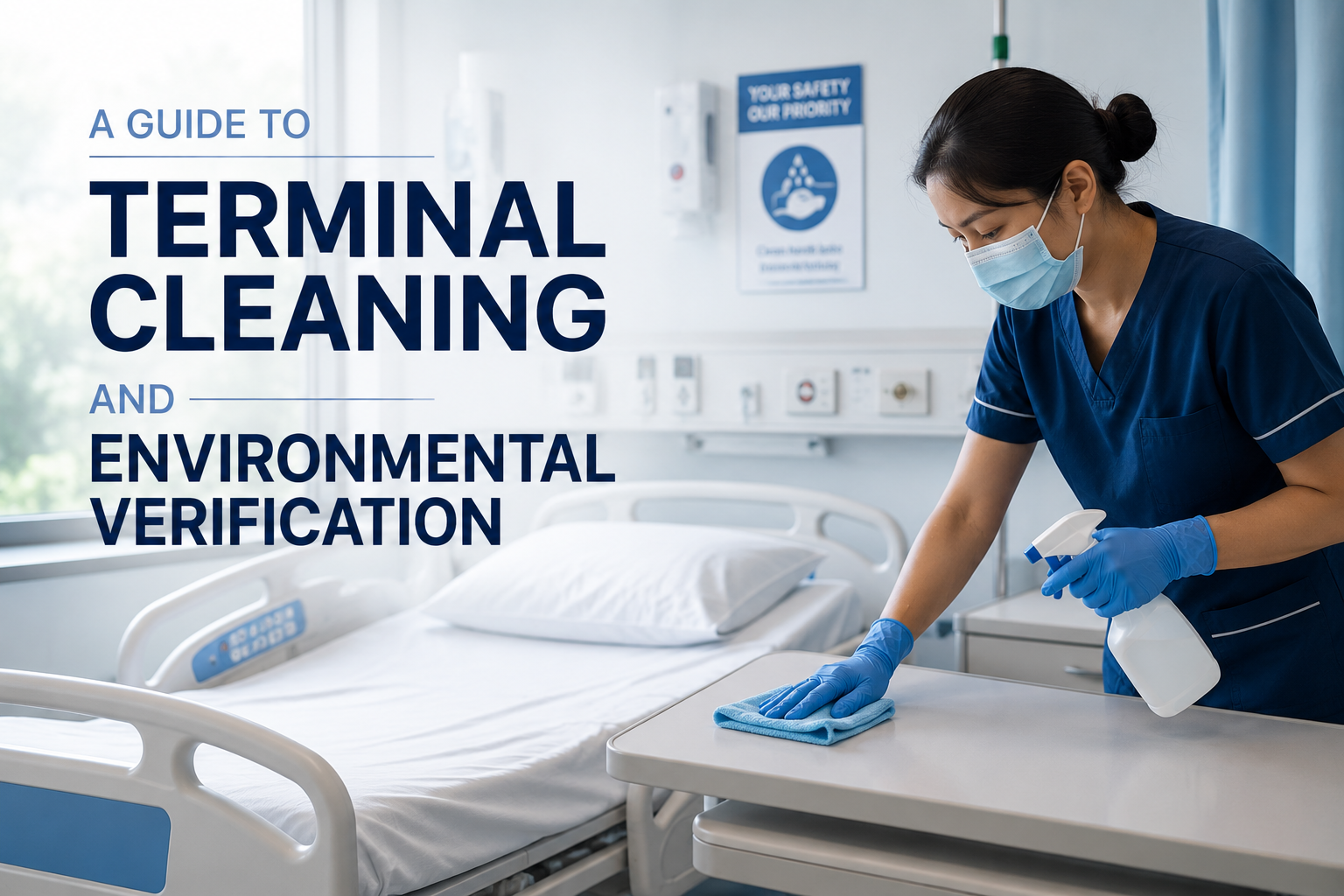
When Is an Operating Theatre Safe to Reopen? A Guide to Terminal Cleaning and Environmental Verification
An operating theatre is a controlled clinical environment.
When that environment is disrupted—whether by an engineering failure, water leak, ventilation problem, construction activity or another incident—the question is not simply:
“Has the room been cleaned?”
The more important question is:
“Have the conditions required for the operating theatre to safely return to service been restored and verified?”
A recent incident at Hospital Ampang brought this distinction into public attention. Following a chilled-water-pipe leak affecting the operating-theatre ventilation system, Malaysia's Ministry of Health (MOH) required measures including re-sterilisation, terminal cleaning and air-particle audits before affected operating theatres could return to service.
The incident offers a useful reminder for healthcare facilities: recovery from an environmental disruption involves more than cleaning visible surfaces. Engineering controls, environmental hygiene, appropriate reprocessing and verification all have different roles.
Why Operating Theatres Require Controlled Environmental Conditions
Operating theatres are not ordinary rooms.
The environment is designed and managed to reduce contamination risks during invasive procedures. This involves several interconnected controls, including:
-
environmental cleaning and disinfection;
-
controlled movement of personnel and materials;
-
ventilation and airflow;
-
filtration;
-
appropriate environmental conditions;
-
equipment and instrument reprocessing;
-
infection-prevention procedures; and
-
monitoring and verification.
Malaysia's MOH infection-control guidance specifically recognises the importance of controlling traffic and activity within surgical areas because the number of people and amount of activity can influence the number of microorganisms present.
The same guidance addresses operating-theatre ventilation, including conventional and ultraclean operating theatres, HEPA filtration and particle-count monitoring.
This means an operating theatre cannot be evaluated solely by whether its floor, walls and equipment look clean.
What Happens When the Controlled Environment Is Disrupted?
The appropriate response depends on the nature and extent of the incident.
A water leak, ventilation failure and construction project do not necessarily create identical risks or require identical corrective actions.
The facility's infection prevention and control, engineering, clinical and other responsible teams therefore need to assess what has been affected before deciding how the environment should be recovered and verified.
A useful way of understanding the process is:
Incident → Isolation → Assessment → Engineering Correction → Environmental Recovery → Verification → Authorised Reopening
Each stage answers a different question.
1. Isolate the affected environment
Where an incident may compromise the controlled environment, continuing normal clinical activity before the risk has been assessed can undermine infection-control measures.
Depending on the incident, affected areas may therefore need to be removed temporarily from clinical service while investigation and corrective work take place.
2. Identify and correct the underlying problem
Cleaning does not repair an engineering failure.
If the disruption involves ventilation, filtration, water systems, building works or another infrastructure issue, the underlying cause needs to be addressed by the appropriate technical personnel.
This distinction is important.
A perfectly cleaned operating theatre with an unresolved environmental-control problem has not necessarily had its original operating conditions restored.
3. Assess what has potentially been affected
The next question is the extent of the environmental impact.
Depending on the event, this assessment may consider:
-
surfaces;
-
equipment;
-
medical devices;
-
ventilation systems;
-
filtration;
-
ceiling or building infrastructure;
-
water exposure;
-
dust or construction debris;
-
storage areas; and
-
adjacent controlled spaces.
The response should be based on the actual incident rather than assuming every environmental disruption requires the same procedure.
Terminal Cleaning: Restoring the Environmental Surface Condition
Terminal cleaning is more comprehensive than ordinary routine cleaning.
In healthcare, it involves a structured cleaning and disinfection process carried out according to defined procedures following particular circumstances.
It should not be confused with simply performing an additional round of routine cleaning.
Malaysia's MOH guidance provides an especially useful example in relation to failed operating-theatre particle counts.
Where an OT fails a particle-count test, the guidance describes actions including notifying hospital administration and engineering, closing the affected OT, addressing the air-handling system and HEPA filter, restarting the air-handling unit, performing terminal cleaning and subsequently retesting.
Most importantly, the guidance states that the affected operating theatre should not be utilised until the measurements are within the recommended standards.
Terminal cleaning is therefore one component of a larger recovery process. Not the sole determinant of whether the theatre can reopen.
Cleaning, Disinfection and Sterilisation Are Not the Same Thing
These terms are sometimes used interchangeably in everyday conversation, but they describe different processes.
Cleaning removes soil, organic matter and contamination from surfaces or items.
Disinfection uses an appropriate process or product to inactivate microorganisms to the level intended for that application.
Sterilisation is a validated process intended to render an item free from viable microorganisms and is associated with appropriately reprocessed medical devices and other suitable items.
Environmental surface disinfection should therefore not automatically be described as “sterilising the operating theatre.”
Similarly, if an incident requires instruments or reusable medical devices to undergo reprocessing or re-sterilisation, that process is separate from terminal environmental cleaning.
Understanding these distinctions helps prevent an important operational mistake:
Using a stronger-sounding term does not mean a higher level of environmental safety has been demonstrated.
Why Ventilation Matters
Operating-theatre environmental control extends beyond surfaces. Air supplied to the theatre is part of the controlled environment. Malaysia's MOH IPC guidance describes different operating-theatre ventilation arrangements and provides requirements around particle-count monitoring.
Ventilation performance can be influenced by factors including:
-
air-handling systems;
-
filtration;
-
HEPA-filter condition;
-
airflow;
-
room pressure relationships;
-
engineering alterations; and
-
activity within the operating theatre.
This is why an incident involving the ventilation system cannot necessarily be resolved through environmental surface cleaning alone.
What Is an Air Particle Count?
An air-particle counter measures the number of airborne particles within specified particle-size ranges.
Particle counting can therefore provide information about the performance and cleanliness of a controlled air environment against applicable criteria.
Malaysia's MOH IPC guidance specifies particle-count monitoring for operating theatres and identifies circumstances where testing should be performed, including after HEPA-filter replacement, increased reported OT infections and alterations or construction within an OT.
But there is an important limitation:
An air-particle counter counts particles. It does not determine whether each particle is a microorganism.
A particle may originate from numerous sources.
Therefore:
Particle count ≠ microbial count
and:
A passing particle-count result does not, by itself, prove that an operating theatre is sterile.
This distinction is essential when interpreting environmental-monitoring results.
Particle Counting and Air Sampling Answer Different Questions
Healthcare environmental monitoring can involve several different methods.
They should not automatically be treated as interchangeable.
Particle counting assesses airborne particulate levels within defined size ranges.
Microbiological air sampling, where indicated, is intended to assess viable microorganisms captured using the particular sampling method.
The Infection Control Unit at Hospital Selayang, for example, lists both air sampling and air particulate counting among its infection-control monitoring activities.
This illustrates an important principle:
Different verification tools exist because they answer different questions.
Environmental Verification Goes Beyond Air
The same principle applies to surface hygiene.
Environmental-cleanliness monitoring may include methods such as:
-
visual assessment;
-
process observation;
-
fluorescent markers;
-
ATP testing; and
-
microbiological methods where appropriate.
Malaysia's MOH Infection Prevention and Control Unit maintains a dedicated Healthcare Environment Cleanliness Audit programme, including visual-assessment and reporting resources.
No single test should automatically be interpreted as proving every aspect of environmental safety.
Instead, the appropriate verification method should correspond to the question being asked.
What Should Be Verified Before Reopening?
There is no single universal checklist that can determine whether every operating theatre affected by every type of incident is safe to reopen.
Requirements depend on factors such as:
-
the nature of the incident;
-
the extent of environmental disruption;
-
the operating-theatre classification;
-
applicable engineering requirements;
-
infection-prevention assessment;
-
facility policies;
-
applicable standards and guidance; and
-
results of the required verification activities.
However, conceptually, the recovery process can be viewed through several control points.
Engineering
Has the underlying infrastructure or ventilation problem been corrected?
Environment
Has the affected environment undergone the required cleaning and disinfection?
Equipment and Devices
Have affected reusable medical devices or equipment been appropriately assessed and reprocessed where required?
Air Environment
Have ventilation and filtration performance been restored and the required environmental measurements completed?
Verification
Do the required test and assessment results meet the applicable criteria?
Authorisation
Have the responsible clinical, infection-control, engineering and/or facility authorities approved the area for return to service according to facility procedures?
Only when the relevant requirements have been satisfied should reopening be considered.
Clean Does Not Automatically Mean Verified
One of the most important lessons from environmental hygiene is that performing an activity and verifying its outcome are different things.
A floor can be mopped.
A surface can be disinfected.
A ventilation system can be repaired.
A HEPA filter can be replaced.
But professional environmental control also asks:
Was the required process completed correctly, and has the required outcome been demonstrated?
That is why environmental verification matters.
A Systems Approach to Operating-Theatre Recovery
Rather than viewing environmental hygiene as an isolated cleaning activity, healthcare facilities can think about recovery as an interconnected system:
Correct the cause
↓
Restore the environment
↓
Perform required cleaning, disinfection and reprocessing
↓
Restore engineering and ventilation controls
↓
Conduct required environmental verification
↓
Review results
↓
Authorise return to clinical use
This approach separates the different responsibilities involved while connecting them to a common objective: restoring a controlled environment suitable for clinical operations.
The Practical Takeaway
The safest question after an operating-theatre environmental incident is not:
“Have we cleaned it?”
It is:
“Have the affected systems and environment been restored, assessed and verified according to the requirements applicable to this operating theatre?”
Terminal cleaning is important.
Engineering controls are important.
Air-particle monitoring can be important.
Reprocessing of affected equipment may be important.
But none should automatically be treated as a standalone declaration that an operating theatre is safe or sterile.
In a controlled healthcare environment, reopening should follow verified recovery—not simply completed cleaning.
Sources
Ministry of Health Malaysia — Policies and Procedures on Infection Prevention and Control, Third Edition (2019).
Ministry of Health Malaysia / Malaysia One Health Antimicrobial Resistance — Healthcare Environment Cleanliness Audit.
Ministry of Health Malaysia, Hospital Selayang — Infection Control Unit environmental monitoring activities.
Bernama — Reporting concerning the operating-theatre disruption and recovery measures at Hospital Ampang.
Editorial Note
This article provides general educational information about environmental hygiene and infection prevention. Requirements for reopening an operating theatre should be determined by the healthcare facility's responsible clinical, infection-prevention, engineering and other authorised personnel in accordance with applicable Malaysian requirements, facility policies and relevant standards.
Ready to standardise your disinfection protocol?
Talk to our team about implementing PRO SolvTab™ CARE across your operation.
Related articles
Can You Actually Sanitise a Used Sponge—or Is Replacing It Safer?
Can you really sanitise a used kitchen sponge? Learn why sponges harbour contamination, which sanitising methods help, and when replacement is the safer option.
How Does ATP Testing Work?
A Practical Guide to ATP Hygiene Monitoring and Surface Cleanliness Verification
Disinfectant Tablet Dilution: How to Calculate the Right Concentration
A Practical Guide to PPM, Water Volume, and Accurate Disinfectant Preparation