
Why Controlled-Dose Disinfectant Tablets Improve Hygiene Consistency
How Standardised Disinfectant Preparation Reduces Human Error Across Healthcare and Food Operations
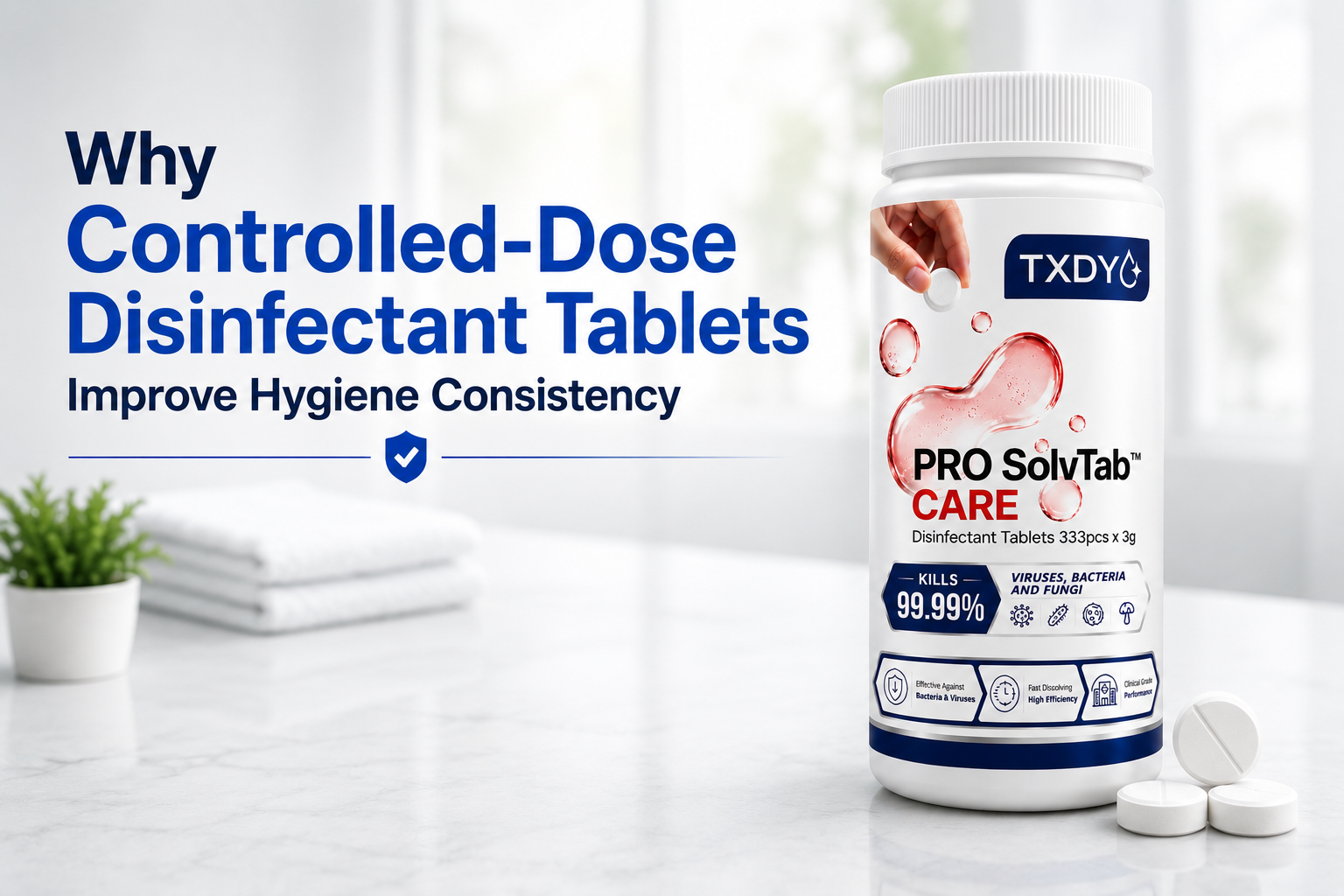
Why Controlled-Dose Disinfectant Tablets Improve Hygiene Consistency
When organisations investigate hygiene failures, they often begin by asking whether they have chosen the right disinfectant.
In my experience, that's usually the wrong place to start.
After working with hospitals, food manufacturers, aged care facilities, and facility management companies for many years, I've found that the disinfectant itself is rarely the weakest link.
More often, the problem lies in how the disinfectant is prepared.
One shift follows the dilution chart exactly.
The next estimates the water volume.
Someone else uses a different measuring jug.
Another tops up yesterday's solution instead of preparing a fresh batch.
Everyone believes they're following the same procedure.
In reality, they're producing different disinfectant concentrations.
This is precisely why many organisations are moving towards controlled-dose disinfectant tablets.
The objective isn't to change the chemistry.
It's to make correct preparation easier to achieve consistently.
The Hidden Cost of Inconsistent Dilution
Most organisations can calculate how much they spend purchasing disinfectants.
Very few calculate the cost of inconsistent preparation.
When disinfectants are mixed incorrectly, the consequences may include:
-
Reduced microbial control
-
Increased chemical consumption
-
Product wastage
-
Material compatibility issues
-
Inconsistent cleaning outcomes
-
Failed verification tests
-
Additional staff retraining
-
Greater audit scrutiny
Individually, these problems may seem minor.
Collectively, they create unnecessary operational risk.
Good hygiene depends on consistency, not guesswork.
Why Human Error Happens
It's easy to blame staff when disinfectants are prepared incorrectly.
In reality, most errors occur because the system allows them to happen.
I've observed preparation areas where staff had to calculate dilution ratios, convert litres into millilitres, identify the correct concentrate, locate measuring equipment, and prepare different products for different applications—all while managing busy operational schedules.
The more manual decisions people must make, the greater the opportunity for inconsistency.
Good hygiene systems should reduce unnecessary complexity, not add to it.
What Are Controlled-Dose Disinfectant Tablets?
Controlled-dose disinfectant tablets are pre-measured formulations designed to produce a target disinfectant concentration when dissolved in the correct volume of water according to the manufacturer's instructions.
Instead of manually measuring liquid concentrates, users simply prepare the solution using the specified number of tablets and water volume.
This doesn't eliminate the need for staff training.
It simplifies one of the most variable parts of the hygiene process.
Why Consistency Matters More Than Strength
One misconception I've encountered repeatedly is the belief that stronger disinfectant automatically provides better protection.
Professional hygiene doesn't work that way.
The objective is not the highest possible chemical concentration.
The objective is the correct concentration for the intended application.
Too little disinfectant may reduce effectiveness.
Too much may increase costs, affect material compatibility, and expose staff to unnecessary chemical concentrations.
Consistency is what allows hygiene programmes to produce repeatable outcomes.
The Operational Benefits of Controlled Dosing
Organisations that adopt controlled-dose systems often do so for operational reasons rather than chemical ones.
Improved Preparation Consistency
Pre-measured dosing helps reduce variability between operators, departments, and shifts.
Simplified Staff Training
New employees can learn standard preparation procedures more quickly when manual chemical measuring is reduced.
Easier Inventory Management
Counting tablets often provides more predictable stock forecasting than estimating liquid concentrate consumption.
Better Storage Efficiency
Tablet formats occupy less storage space than equivalent volumes of ready-to-dilute liquid products.
Improved Operational Standardisation
Standardised preparation supports more consistent cleaning and disinfection procedures across multiple facilities.
Where Controlled-Dose Systems Deliver the Greatest Value
While many industries benefit from standardised disinfectant preparation, controlled-dose systems are particularly valuable where consistency is critical.
These include:
-
Hospitals
-
Clinics
-
Aged care facilities
-
Food manufacturing plants
-
Commercial kitchens
-
Laboratories
-
Facility management operations
-
Educational institutions
In environments where multiple people prepare disinfectants every day, reducing variation becomes a significant operational advantage.
Putting Consistency Into Practice with TXDY PRO SolvTab CARE
One example of this approach is TXDY PRO SolvTab CARE.
Rather than relying on manual measurement of liquid concentrates, TXDY PRO SolvTab CARE is a controlled-dose NaDCC disinfectant tablet developed to support more consistent disinfectant preparation across professional environments.
When prepared according to the product's dilution instructions, it helps organisations standardise chlorine concentration, simplify staff training, improve storage efficiency, and reduce variability associated with manual chemical measuring.
For healthcare facilities, aged care providers, food manufacturers, and facility management companies, this supports a more structured and repeatable hygiene programme.
Importantly, products like TXDY PRO SolvTab CARE are not a replacement for good hygiene systems.
Successful disinfection still depends on:
-
Proper cleaning before disinfection
-
Correct preparation
-
Appropriate contact time
-
Staff competency
-
Routine verification
-
Ongoing supervision
A well-designed product supports good hygiene practices—it does not replace them.
Common Mistakes to Avoid
Even with controlled-dose systems, organisations should avoid several common mistakes.
-
Using the wrong water volume.
-
Preparing solutions without following dilution instructions.
-
Reusing disinfectant beyond recommended replacement intervals.
-
Assuming stronger concentrations provide better protection.
-
Neglecting routine staff training.
Controlled dosing reduces one source of variability, but good hygiene still requires disciplined execution.
Final Thoughts
The strongest hygiene programmes I've encountered over the years all have one characteristic in common:
They make it easy for people to do the right thing consistently.
Controlled-dose disinfectant tablets don't change the science of disinfection.
They improve the consistency of how that science is applied in everyday operations.
For organisations looking to strengthen hygiene programmes, improve standardisation, and reduce unnecessary preparation errors, simplifying disinfectant preparation can be one of the most effective operational improvements available.
Because in professional hygiene, consistency isn't just about compliance.
It's about delivering the same safe outcome, every shift, every day.
Frequently Asked Questions
What are controlled-dose disinfectant tablets?
They are pre-measured disinfectant tablets designed to produce a target disinfectant concentration when dissolved in the correct volume of water according to the manufacturer's instructions.
Why do organisations use controlled-dose tablets?
They help improve preparation consistency, simplify staff training, reduce manual measuring, improve inventory management, and support more standardised hygiene procedures.
Is TXDY PRO SolvTab CARE suitable for professional environments?
TXDY PRO SolvTab CARE is developed for professional hygiene applications where consistent disinfectant preparation and operational reliability are important. Users should always follow the product instructions and local regulatory requirements for their specific environment.
Are disinfectant tablets better than liquid disinfectants?
Neither format is inherently better. The most appropriate choice depends on operational workflow, staff training, storage, and preparation requirements. Controlled-dose tablets are often selected where standardisation and consistency are priorities.
Ready to standardise your disinfection protocol?
Talk to our team about implementing PRO SolvTab™ CARE across your operation.
Related articles
The Technical Guide to NaDCC Disinfectant Tablets: Chemistry, Dilution, and Operational Implementation
An objective, technical guide to NaDCC tablets: HOCl chemistry, bleach comparison, pathogen kill rates, ppm dilution charts, and safety protocols.
What is Disinfection?
A Practical Guide to Understanding Disinfection and Why It Matters in Real-World Hygiene
What is Hygiene?
Understanding the Foundation of Health, Safety, and Infection Prevention