
What is Disinfection?
A Practical Guide to Understanding Disinfection and Why It Matters in Real-World Hygiene
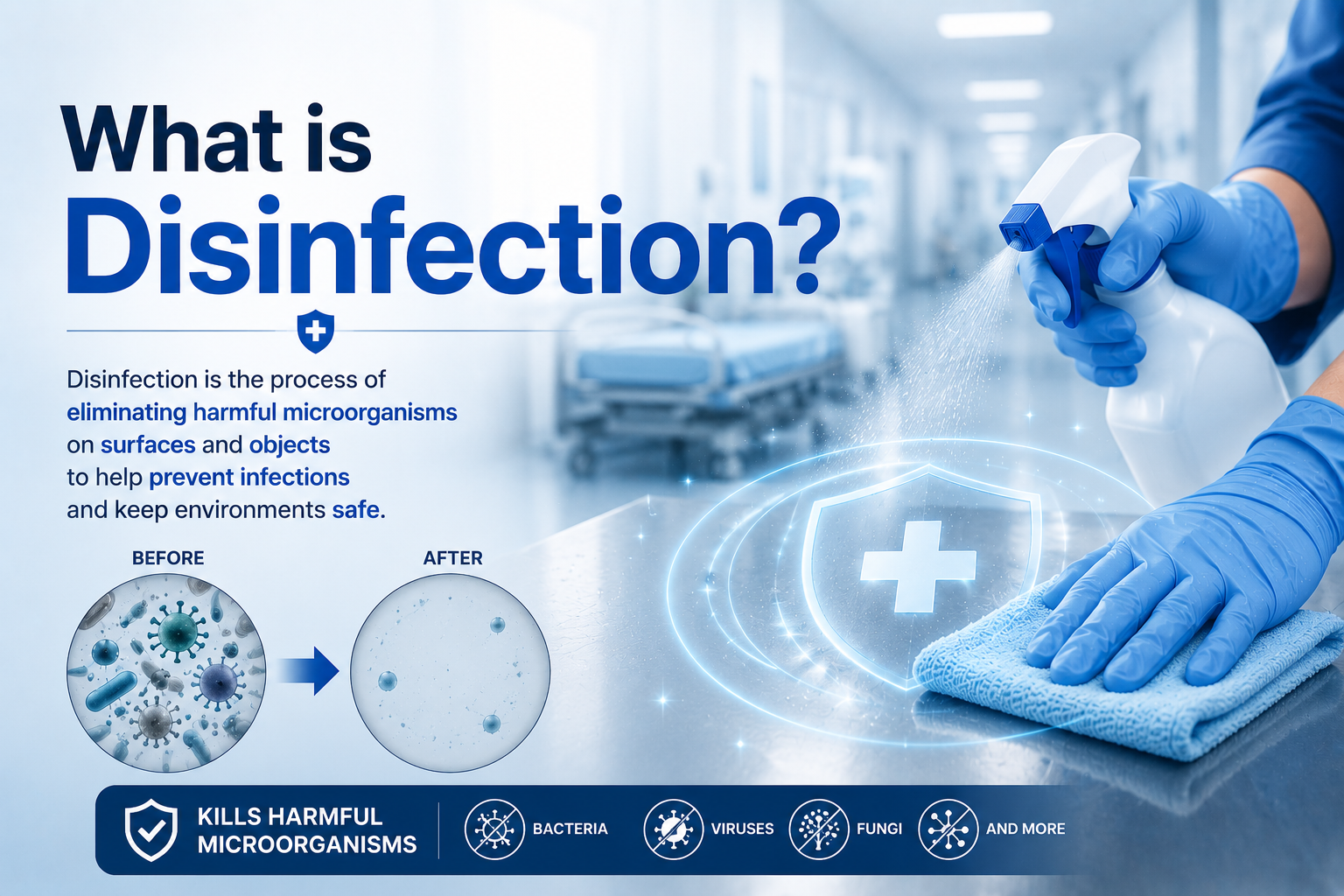
What is Disinfection?
Walk into almost any workplace today and you'll hear someone say:
"Don't worry, we've disinfected it."
The question I usually ask next is:
"What do you mean by disinfected?"
More often than not, the answer is surprisingly vague.
Sometimes the surface was simply wiped with a damp cloth.
Sometimes a general-purpose cleaner was used.
Sometimes a disinfectant was sprayed and immediately wiped away before it had any chance to work.
This highlights one of the biggest misconceptions in hygiene.
Disinfection isn't something that happens because you spray a product onto a surface.
It's a controlled process designed to reduce the risk of disease transmission by inactivating harmful microorganisms.
After more than a decade working with healthcare facilities, food manufacturers, commercial buildings, and facility management teams, I've found that most disinfection failures don't happen because organisations buy the wrong product.
They happen because people misunderstand what disinfection actually is.
What is Disinfection?
Disinfection is the process of using chemical or physical methods to inactivate or destroy harmful microorganisms on surfaces or objects, reducing the risk of infection.
Unlike cleaning, which removes visible dirt and contaminants, disinfection specifically targets microorganisms such as bacteria, viruses, and many fungi.
The goal isn't to make a surface look cleaner.
The goal is to make it safer.
It's important to understand that disinfection does not necessarily eliminate every microorganism.
That level of microbial destruction is associated with sterilisation, which is a different process used for critical medical instruments and specialised applications.
Disinfection reduces microbial contamination to a level appropriate for the intended environment and level of risk.
Why Do We Disinfect?
The answer is simple.
Because microorganisms move.
They move from hands to door handles.
From bed rails to healthcare workers.
From shopping trolley handles to customers.
From food preparation benches to ready-to-eat meals.
Most people never see this happening because microorganisms are invisible.
Professional hygiene isn't based on reacting after illness occurs. It's based on interrupting these transmission pathways before they become a problem. Disinfection is one of the tools used to break that chain.
Cleaning and Disinfection Are Different Processes
This is probably the most important lesson anyone working in hygiene should understand.
Cleaning and disinfection are partners.
They're not competitors.
Cleaning removes:
-
Dirt
-
Dust
-
Grease
-
Blood
-
Food residues
-
Organic matter
Disinfection targets microorganisms that remain after cleaning.
One mistake I still see surprisingly often is staff spraying disinfectant directly onto visibly dirty surfaces.
The intention is good.
The result often isn't.
Organic matter can reduce the effectiveness of many disinfectants by preventing the active ingredients from reaching microorganisms effectively.
That's why experienced infection prevention teams almost always follow a simple principle:
Clean first. Disinfect second.
How Does Disinfection Work?
Different disinfectants work in different ways.
Some damage the protective outer structure of microorganisms.
Others interfere with proteins or enzymes essential for survival.
Some disrupt genetic material.
Regardless of the chemistry, the objective is the same:
Prevent microorganisms from surviving or reproducing.
For chlorine-based disinfectants such as NaDCC and sodium hypochlorite, the active antimicrobial agent is hypochlorous acid (HOCl).
This highly effective compound attacks microorganisms rapidly when prepared at the correct concentration and allowed sufficient contact time.
The science behind disinfection is well established.
What usually determines success isn't the chemistry.
It's how consistently that chemistry is applied.
When Should Surfaces Be Disinfected?
Not every surface needs routine disinfection.
One of the most common operational mistakes is assuming every area requires hospital-level hygiene.
Professional hygiene should always be risk-based.
Disinfection is generally appropriate for:
-
Healthcare environments
-
Patient care areas
-
High-touch surfaces
-
Clinical equipment (where compatible)
-
Food processing environments where required
-
Areas contaminated by blood or body fluids
-
Isolation rooms
-
Laboratories
-
Shared equipment during outbreaks
By contrast, many low-risk office surfaces may only require routine cleaning unless there is a specific contamination risk.
Using disinfectants where they provide little additional benefit increases costs without necessarily improving hygiene.
The Four Things That Determine Whether Disinfection Works
People often ask me which disinfectant is the "best."
My answer is usually:
"The one that's used correctly."
Even an excellent disinfectant can perform poorly if basic principles aren't followed.
1. Correct Concentration
Preparing disinfectant too weak may reduce its effectiveness.
Preparing it stronger than necessary doesn't automatically improve results and may create unnecessary chemical exposure, increase costs, or affect material compatibility.
The correct concentration is always the one recommended for the intended application.
2. Contact Time
One of the biggest mistakes I see is spraying disinfectant onto a surface and wiping it away immediately.
Most disinfectants require time to work.
If they're removed too quickly, microorganisms may not be adequately inactivated.
Always follow the manufacturer's recommended contact time.
3. Proper Surface Preparation
Disinfectants aren't designed to remove heavy dirt.
Cleaning removes contamination.
Disinfection manages microorganisms.
Skipping the cleaning stage often reduces the effectiveness of the disinfectant.
4. Correct Product Selection
Different environments have different requirements.
A disinfectant suitable for a hospital may not be the best choice for a food-contact surface.
Likewise, products intended for general environmental cleaning may not be appropriate for high-risk healthcare settings.
Selecting the right product is just as important as using it correctly.
Common Disinfection Mistakes
After years of visiting healthcare facilities, factories, and commercial sites, the same issues appear repeatedly.
Confusing Fragrance with Hygiene
A pleasant smell does not indicate effective disinfection.
Some of the most effective disinfectants have very little fragrance.
Likewise, heavily perfumed products are not necessarily disinfectants.
Guessing Dilution Ratios
I've watched staff estimate disinfectant by eye because "that's how we've always done it."
Consistency disappears the moment preparation becomes guesswork.
Controlled dosing, proper measuring equipment, or automated dilution systems significantly improve reliability.
Focusing on Floors Instead of High-Touch Surfaces
Floors often receive the most attention because they're highly visible.
Yet from an infection prevention perspective, bed rails, light switches, taps, keyboards, lift buttons, door handles, and shared equipment usually present a much greater opportunity for disease transmission.
Cleaning programmes should reflect actual risk, not just what people notice first.
Assuming More Chemical Means Better Hygiene
Using excessive disinfectant is not a substitute for good hygiene practices.
Effective disinfection depends on selecting the right product, preparing it correctly, applying it properly, and allowing the required contact time.
More chemical does not automatically mean more protection.
Disinfection Is Part of a Bigger Hygiene System
One lesson I've learned over the years is that organisations with the strongest hygiene outcomes rarely focus on disinfectants alone.
They build complete systems.
Those systems include:
-
Staff training
-
Hand hygiene
-
Cleaning procedures
-
Correct disinfectant preparation
-
Colour-coded equipment
-
Routine monitoring
-
Standard operating procedures
-
Ongoing supervision
Disinfection is one important component—but it's only one component.
No disinfectant can compensate for poor hygiene systems.
Final Thoughts
Disinfection is often misunderstood because people associate it with products rather than processes.
In reality, successful disinfection isn't achieved simply by purchasing an effective disinfectant.
It's achieved by understanding when disinfection is necessary, selecting the appropriate product, preparing it correctly, allowing sufficient contact time, and integrating it into a well-designed hygiene programme.
After years of working across healthcare, food production, and commercial facilities, I've found that the organisations achieving the best hygiene outcomes aren't necessarily the ones using the most disinfectant.
They're the ones that apply it consistently, appropriately, and as part of a structured infection prevention strategy.
Ultimately, disinfection isn't about making people feel safer.
It's about reducing real, measurable risks in the environments where people live, work, receive care, and prepare food.
Frequently Asked Questions
What is disinfection?
Disinfection is the process of using chemical or physical methods to inactivate or destroy harmful microorganisms on surfaces or objects, reducing the risk of disease transmission.
Is cleaning the same as disinfection?
No. Cleaning removes visible dirt and organic matter, while disinfection targets microorganisms. In many situations, cleaning should be completed before disinfection for the disinfectant to work effectively.
Does disinfection kill every microorganism?
No. Disinfection reduces harmful microorganisms to an appropriate level for the intended use but does not necessarily eliminate every microorganism. Sterilisation is a separate process that achieves a higher level of microbial destruction.
When should surfaces be disinfected?
Disinfection is typically recommended for healthcare environments, high-touch surfaces, food processing areas where appropriate, body fluid contamination, and other situations where there is an increased risk of infection.
Ready to standardise your disinfection protocol?
Talk to our team about implementing PRO SolvTab™ CARE across your operation.
Related articles
The Technical Guide to NaDCC Disinfectant Tablets: Chemistry, Dilution, and Operational Implementation
An objective, technical guide to NaDCC tablets: HOCl chemistry, bleach comparison, pathogen kill rates, ppm dilution charts, and safety protocols.
Why Controlled-Dose Disinfectant Tablets Improve Hygiene Consistency
How Standardised Disinfectant Preparation Reduces Human Error Across Healthcare and Food Operations
What is Hygiene?
Understanding the Foundation of Health, Safety, and Infection Prevention