
Cleaning vs Sanitising vs Disinfecting
Understanding the Differences and Why Choosing the Right Process Matters
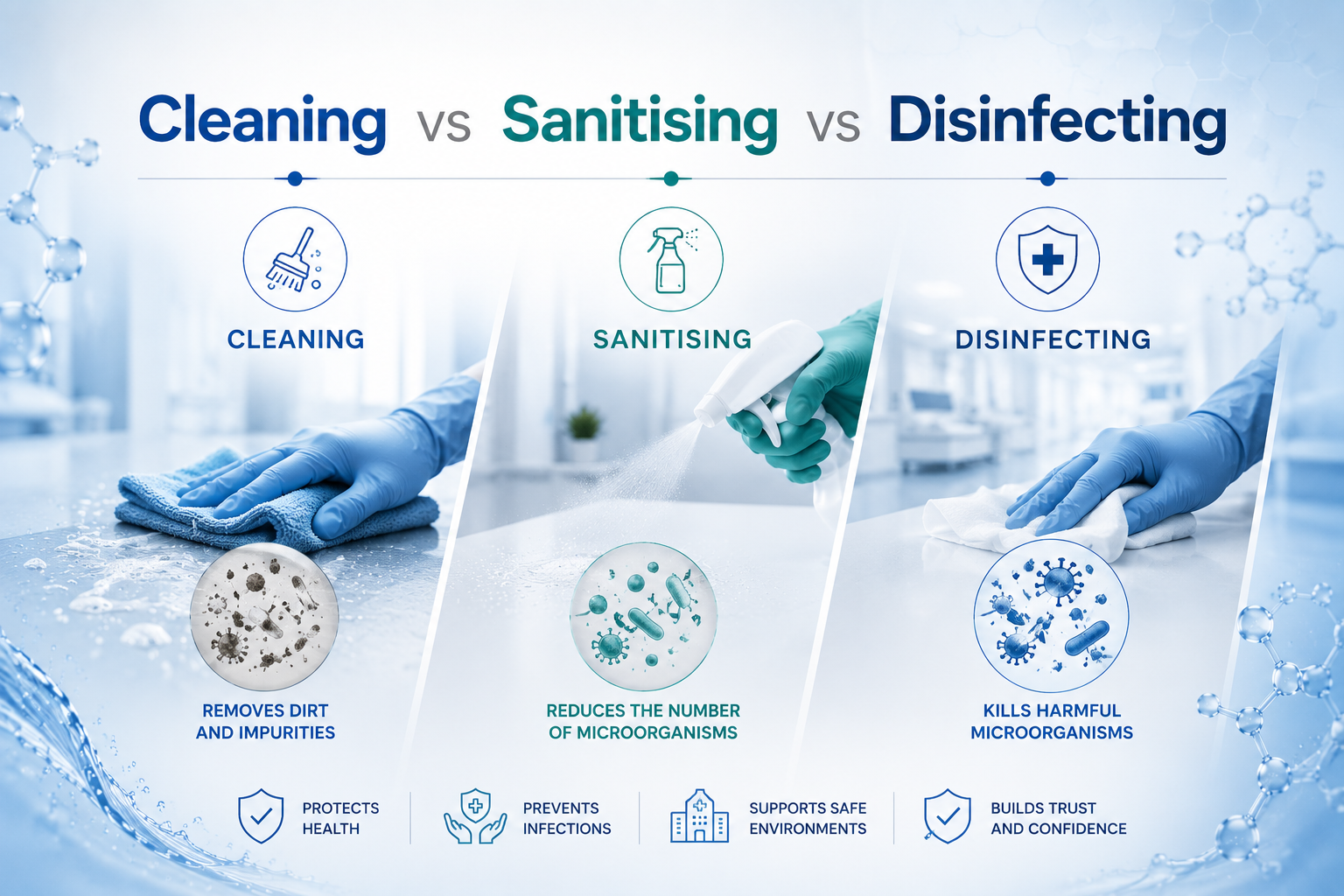
Cleaning, Sanitising and Disinfecting Are Not the Same Thing
One of the most common misconceptions I encounter—whether in hospitals, restaurants, factories, or commercial buildings—is hearing these three words used interchangeably.
"We've disinfected the table."
When I ask what product was used, the answer is often:
"Just a general-purpose cleaner."
Or someone says:
"We've sanitised everything."
Only to discover they actually disinfected the surface.
These may sound like small language differences, but in professional hygiene, they're significant. Each process has a different objective, a different level of microbial control, and a different role in maintaining a safe environment.
Using the wrong process can create unnecessary risk. It can also lead to wasted time, increased chemical costs, or a false sense of security.
The key isn't deciding which process is "best."
The key is understanding when each one is appropriate.
The Simple Explanation
Before diving deeper, here's the easiest way to remember the differences:
-
Cleaning removes dirt.
-
Sanitising reduces microorganisms to safer levels.
-
Disinfecting inactivates or destroys a broader range of harmful microorganisms on surfaces.
These three processes work together—not against each other.
In most professional hygiene programmes, cleaning comes first. Sanitising or disinfecting follows depending on the level of hygiene required.
What is Cleaning?
Cleaning is the physical removal of visible contamination from a surface.
This includes:
-
Dust
-
Dirt
-
Grease
-
Food residue
-
Blood
-
Organic matter
-
Debris
Cleaning doesn't necessarily kill microorganisms.
Instead, it removes the material that microorganisms live in or cling to.
Think about washing a muddy floor.
After cleaning, the floor looks much better.
But appearance alone doesn't tell you whether harmful bacteria or viruses remain.
Cleaning improves appearance and removes contaminants, but it doesn't always achieve the level of microbial control required in higher-risk environments.
Why Cleaning Comes First
One lesson every experienced hygiene professional learns is this:
Disinfectants work best on clean surfaces.
Organic matter such as blood, food residues, grease, and body fluids can interfere with the performance of many disinfectants.
I've seen organisations spend thousands of ringgit on premium disinfectants while overlooking one basic principle:
If the surface hasn't been cleaned properly first, the disinfectant may not perform as intended.
Cleaning prepares the surface.
Disinfection completes the hygiene process.
Skipping the first step often reduces the effectiveness of the second.
What is Sanitising?
Sanitising sits between cleaning and disinfecting.
Its objective is to reduce the number of microorganisms to a level considered acceptable according to public health or regulatory standards.
Unlike disinfection, sanitising doesn't necessarily eliminate every harmful microorganism.
Instead, it lowers microbial contamination to reduce the risk of disease transmission in situations where complete disinfection isn't required.
Sanitising is commonly used in:
-
Food preparation areas
-
Commercial kitchens
-
Cafés
-
Restaurants
-
Food manufacturing
-
Childcare facilities
For example, after washing a food preparation bench, a food-safe sanitiser may be applied to reduce bacterial levels before food is prepared.
The goal is to create a surface that is safe for its intended use.
What is Disinfecting?
Disinfection is the process of using chemical or physical methods to inactivate or destroy harmful microorganisms on surfaces.
Unlike cleaning, disinfection specifically targets microorganisms.
Unlike sanitising, disinfection generally aims for a higher level of microbial control.
Disinfection is commonly required in:
-
Hospitals
-
Clinics
-
Dental practices
-
Laboratories
-
Ambulances
-
Isolation rooms
-
Aged care facilities
It is also used whenever there is an increased risk of infectious disease transmission.
It's important to remember that disinfectants require the correct:
-
Concentration
-
Contact time
-
Preparation
-
Application method
Simply spraying a disinfectant and immediately wiping it away rarely provides the intended level of microbial control.
A Practical Example
Imagine preparing a kitchen bench after handling raw chicken.
Step 1: Cleaning
You remove food scraps, grease, and visible contamination using a suitable cleaning product.
At this point, the surface looks clean.
Step 2: Sanitising
If you're preparing food, a food-safe sanitiser may be used to reduce bacteria to levels considered safe for food preparation.
The surface is now suitable for its intended purpose.
Now imagine a hospital treatment room after a patient with an infectious disease has been discharged.
Cleaning alone isn't enough.
After removing visible contamination, an appropriate disinfectant is applied according to established infection prevention procedures.
The objective isn't simply cleanliness.
It's reducing the risk of disease transmission to the next patient and healthcare worker.
Same principle.
Different level of risk.
Different hygiene requirement.
Which One Should You Use?
The answer depends entirely on the environment.
Cleaning is appropriate when:
-
Removing visible dirt
-
Routine housekeeping
-
Preparing surfaces for further treatment
-
Improving appearance
Sanitising is appropriate when:
-
Preparing food-contact surfaces
-
Reducing microbial levels in food environments
-
Meeting food safety requirements
Disinfecting is appropriate when:
-
Managing infectious disease risks
-
Healthcare environments
-
Clinical settings
-
High-touch surfaces
-
Body fluid contamination
-
Outbreak response
The process should always match the level of risk.
Common Mistakes Organisations Make
After years of observing cleaning operations across different industries, several mistakes appear repeatedly.
Using a Cleaner Instead of a Disinfectant
Many general-purpose cleaners remove dirt effectively but are not designed to control microorganisms.
A surface may look spotless while remaining microbiologically contaminated.
Disinfecting Dirty Surfaces
Applying disinfectant directly onto heavy dirt or organic matter often reduces its effectiveness.
Cleaning first is one of the simplest ways to improve disinfection outcomes.
Believing Every Surface Needs Disinfection
Not every environment requires hospital-level disinfection.
Routine office desks, walls, ceilings, and low-risk areas may only require regular cleaning.
Using disinfectants unnecessarily can increase chemical use, costs, and environmental impact without providing additional benefit.
Risk-based hygiene is generally more effective than applying the highest level of treatment everywhere.
Ignoring Contact Time
One of the most overlooked mistakes is wiping disinfectant away too quickly.
Most disinfectants require a specified contact time to achieve their intended level of microbial control.
If the surface dries too quickly or is wiped immediately after application, the disinfectant may not perform as intended.
Always follow the manufacturer's instructions.
Building an Effective Hygiene Programme
Successful hygiene programmes don't rely on one product.
They rely on selecting the appropriate process for each situation.
Ask these questions:
-
Is there visible contamination?
-
Is this a food-contact surface?
-
Is there an infection risk?
-
What level of microbial control is required?
-
Does this environment require cleaning, sanitising, or disinfecting?
These decisions should be based on risk, not habit.
The organisations with the strongest hygiene programmes don't necessarily use more chemicals.
They use the right process at the right time.
Final Thoughts
Cleaning, sanitising, and disinfecting are three separate but complementary components of effective hygiene.
Cleaning removes dirt and prepares surfaces.
Sanitising reduces microorganisms to acceptable levels for specific environments, particularly food-related settings.
Disinfecting provides a higher level of microbial control where infection prevention is critical.
Confusing these terms can lead to ineffective hygiene practices or unnecessary chemical use.
Understanding the differences allows organisations to design more practical, efficient, and evidence-based cleaning programmes that protect people while making the best use of time and resources.
In professional hygiene, success isn't about using the strongest chemical.
It's about choosing the right process for the right level of risk.
Frequently Asked Questions
What is the difference between cleaning, sanitising, and disinfecting?
Cleaning removes dirt and visible contaminants. Sanitising reduces microorganisms to levels considered safe under public health standards, particularly on food-contact surfaces. Disinfecting inactivates or destroys a broader range of harmful microorganisms where infection prevention is required.
Do you always need to clean before disinfecting?
In many situations, yes. Cleaning removes dirt and organic matter that can reduce the effectiveness of disinfectants. Following the manufacturer's instructions and your organisation's procedures is essential.
Is sanitising the same as disinfecting?
No. Sanitising reduces microorganisms to acceptable levels, while disinfecting generally aims for a higher level of microbial control. The appropriate choice depends on the environment and level of risk.
Can one product clean and disinfect?
Some products are formulated to both clean and disinfect when used according to the manufacturer's instructions. However, heavily soiled surfaces may still require a separate cleaning step before disinfection to achieve optimal results.
Ready to standardise your disinfection protocol?
Talk to our team about implementing PRO SolvTab™ CARE across your operation.
Related articles
Can You Actually Sanitise a Used Sponge—or Is Replacing It Safer?
Can you really sanitise a used kitchen sponge? Learn why sponges harbour contamination, which sanitising methods help, and when replacement is the safer option.
When Is an Operating Theatre Safe to Reopen? A Guide to Terminal Cleaning and Environmental Verification
Reopening an operating theatre after an environmental or engineering incident requires more than cleaning alone. Learn how terminal cleaning, ventilation assessment, particle counting and environmental verification work together before clinical operations resume.
How Does ATP Testing Work?
A Practical Guide to ATP Hygiene Monitoring and Surface Cleanliness Verification