
What Is ATP Testing? How to Know If a Surface Is Really Clean
A Practical Guide to ATP Hygiene Monitoring, Surface Cleanliness and RLU Results
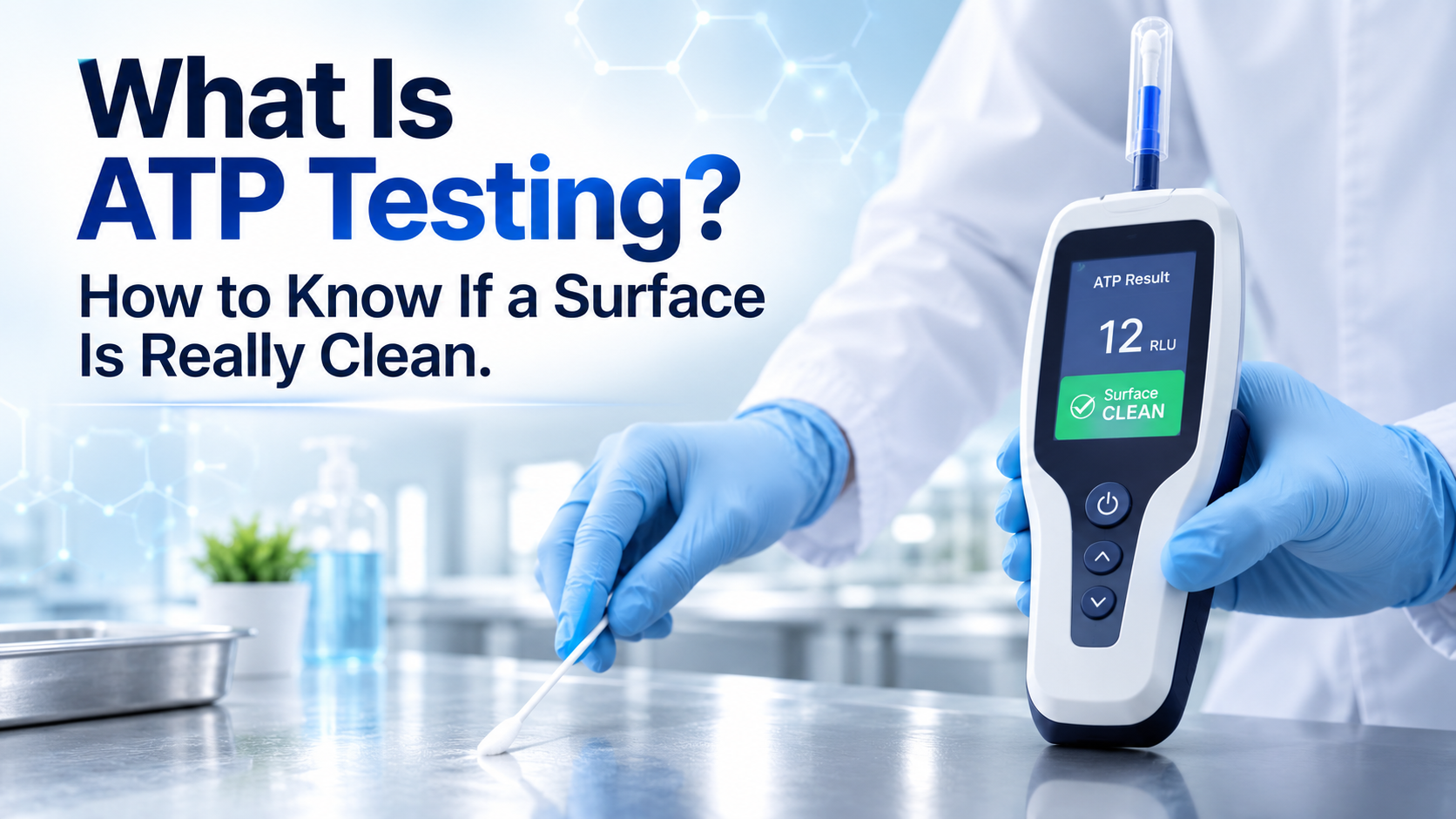
What Is ATP Testing?
One of the most common questions I hear when reviewing a cleaning programme is:
"How do we actually know the surface is clean?"
For many organisations, the answer is still visual inspection.
If the floor looks clean, it passes.
If the stainless steel shines, it passes.
If there's no visible food residue on the production line, it passes.
But after more than a decade working around professional hygiene operations, I've learned that visually clean and measurably clean are two very different things.
A surface can look spotless while still carrying organic residues that indicate incomplete cleaning. This is particularly important in environments such as food manufacturing, healthcare, commercial kitchens, and other hygiene-sensitive operations.
This is where ATP testing can be valuable.
ATP testing gives hygiene teams a rapid way to assess whether cleaning has effectively removed biological and organic residues from a surface. Instead of relying entirely on what the eye can see, teams can collect a swab, test the sample, and receive a numerical result within seconds.
But ATP testing is also widely misunderstood.
A low ATP reading does not automatically mean a surface is sterile.
A high ATP reading does not necessarily mean dangerous bacteria are present.
And an ATP test is not the same as microbiological testing.
To use ATP testing effectively, you first need to understand what it actually measures and, equally importantly, what it doesn't.
What Does ATP Stand For?
ATP stands for adenosine triphosphate.
ATP is an energy-carrying molecule found in living cells and biological material.
In practical hygiene monitoring, ATP may be associated with residues originating from sources such as:
Food
Human cells
Plant material
Microorganisms
Other organic contamination
When these residues remain on a surface after cleaning, ATP testing may detect them.
The principle is relatively straightforward:
More detectable ATP generally produces a stronger test response.
That response is measured by an ATP testing instrument and reported as a numerical value.
The important word here is cleanliness.
ATP testing is primarily a rapid hygiene monitoring tool. It helps indicate whether organic contamination remains after cleaning.
It should not be interpreted as a direct measurement of specific pathogens.
How Does ATP Testing Work?
Most ATP hygiene monitoring systems involve two components:
A specialised ATP swab.
A handheld instrument called a luminometer.
The user swabs a defined surface area, activates the test according to the manufacturer's instructions, and inserts the swab into the luminometer.
A chemical reaction involving ATP produces light.
The luminometer measures this light and reports the result as Relative Light Units, commonly abbreviated as RLU.
In simplified terms:
Higher detectable ATP → Higher light output → Higher RLU reading
Lower detectable ATP → Lower light output → Lower RLU reading
The entire process can take less than a minute.
This speed is one of the biggest reasons ATP testing has become useful for operational hygiene monitoring.
Instead of waiting days for laboratory results, a hygiene team can receive immediate feedback and, where necessary, take corrective action before production begins or an area is released for use.
What Does an ATP Test Actually Tell You?
This is where experience matters.
I've seen ATP testing programmes fail because organisations expect the technology to answer questions it wasn't designed to answer.
An ATP test is useful for answering:
"Was the cleaning process effective at removing detectable organic contamination from this surface?"
It is not designed to definitively answer:
"Is this surface completely free from harmful bacteria?"
Those are two different questions.
A high ATP result may indicate that food residue, biological material, or other organic contamination remains on the surface.
That should trigger investigation.
Perhaps the surface wasn't cleaned properly.
Perhaps an area was missed.
Perhaps the cleaning tool itself was contaminated.
Perhaps the cleaning procedure isn't suitable for that particular equipment.
What ATP testing provides is a rapid warning signal.
It tells you where to look.
What Are RLU Readings?
ATP test results are generally reported as Relative Light Units (RLU).
This is where many new users make their first mistake.
They search online for:
"What is a good ATP reading?" and expect to find one universal number. Unfortunately, it doesn't work that way.
RLU values can vary between ATP testing systems, instruments, swab technologies, environments, surfaces, and monitoring programmes.
A reading considered acceptable under one system may not be directly comparable with a reading from another.
That's why organisations should establish appropriate pass, caution, and fail thresholds based on:
The ATP system being used
Manufacturer guidance
The facility's hygiene requirements
Historical baseline data
Risk level
Internal validation procedures
The number itself matters.
But the trend behind the number often matters even more.
If a production line consistently records low readings and suddenly begins producing significantly higher results, something has changed.
That change deserves investigation.
Why ATP Testing Is Better Than Visual Inspection Alone
Visual inspection still has a role in professional cleaning.
If there's visible food residue on a conveyor, you don't need an ATP test to tell you the surface isn't clean.
The problem is what happens after visible contamination has been removed.
A stainless-steel surface may look immaculate.
But ATP testing may reveal that the cleaning process has left behind organic residues.
I've seen this happen particularly around:
Equipment joints
Conveyor edges
Undersides of machinery
Seals and gaskets
Handles
Hard-to-reach corners
Frequently touched control panels
These areas are easily overlooked during routine cleaning.
ATP testing gives hygiene teams another layer of verification beyond appearance.
The most effective programmes use both.
Visual inspection identifies obvious failures.
ATP testing helps identify less visible cleaning failures.
Where Is ATP Testing Used?
ATP testing is commonly used in environments where cleaning performance needs to be monitored quickly and consistently.
These include:
Food Manufacturing
ATP testing can help verify cleaning effectiveness before production begins and identify areas requiring recleaning.
Commercial Kitchens
Food preparation surfaces and equipment can be monitored as part of routine hygiene verification programmes.
Healthcare
ATP testing may be used as one component of environmental cleanliness monitoring, alongside established infection prevention procedures and other verification methods.
Hospitality
Hotels and other hospitality environments may use ATP monitoring to evaluate cleaning performance in selected high-touch areas.
Pharmaceutical and Controlled Environments
Depending on the facility and applicable requirements, ATP-based monitoring may form part of broader cleaning verification programmes.
The role of ATP testing differs between industries.
It should always be integrated into an appropriate hygiene monitoring system rather than treated as a standalone guarantee of safety.
The Biggest Operational Advantage: Immediate Feedback
For me, one of the greatest advantages of ATP testing isn't the technology.
It's what the technology does to staff behaviour.
Without verification, cleaning can easily become:
"I've cleaned it."
With ATP monitoring, the conversation becomes:
"Let's verify whether the cleaning process achieved the expected result."
That shift is significant.
If an ATP test fails, the surface can potentially be recleaned immediately and tested again.
This creates a feedback loop:
Clean → Test → Identify → Correct → Retest
Over time, this can help hygiene managers identify recurring problems.
Perhaps one machine consistently fails.
Perhaps one shift produces higher readings.
Perhaps a particular cleaning procedure isn't reaching a difficult area.
Perhaps staff need additional training.
ATP data becomes more valuable when organisations stop looking at individual numbers and start looking for patterns.
What ATP Testing Cannot Tell You
This section is critical.
ATP testing has limitations.
It does not directly identify specific microorganisms.
An ATP test cannot tell you:
Whether Salmonella is present
Whether Listeria monocytogenes is present
Whether a specific pathogen has been eliminated
The exact number of viable bacteria on a surface
These questions require appropriate microbiological testing methods.
ATP testing and microbiological testing therefore serve different purposes.
Think of ATP testing as a rapid cleanliness verification tool.
Microbiological testing provides information about microorganisms.
In a mature hygiene programme, these approaches may complement each other rather than compete.
Common ATP Testing Mistakes
After seeing hygiene monitoring programmes implemented across different environments, several mistakes appear repeatedly.
1. Swabbing Different Areas Every Time
If one employee swabs 10 cm² and another swabs 100 cm², comparing their results becomes difficult.
Consistency in sampling technique matters.
2. Testing Only the Easy Surfaces
Flat stainless-steel benches are convenient to test.
They're not always where the biggest hygiene problems occur.
Sampling plans should include difficult-to-clean and higher-risk locations.
3. Treating ATP as a Pathogen Test
A low ATP result should never be interpreted as proof that a surface is free from pathogens.
ATP testing measures cleanliness indicators—not specific disease-causing organisms.
4. Chasing Individual Numbers
One failed result matters.
But repeated failures in the same location matter more.
Trend analysis can reveal weaknesses that individual readings may miss.
5. Testing Without Taking Corrective Action
There's little value in collecting ATP data if nothing happens when a result fails.
Every monitoring programme should define:
What constitutes a failure
Who is responsible
What corrective action is required
When retesting should occur
How recurring failures are investigated
Measurement without action is just data collection.
How Cleaning and Disinfection Affect ATP Results
Another common misunderstanding is assuming that ATP testing measures disinfection effectiveness.
Not directly.
Cleaning and disinfection have different objectives.
Cleaning removes dirt and organic contamination.
Disinfection targets microorganisms.
Because ATP testing detects biological and organic residues, it is particularly useful for evaluating the effectiveness of the cleaning process.
A surface that has been poorly cleaned may still produce a high ATP reading even after disinfectant has been applied.
This reinforces an important principle in professional hygiene:
Disinfection does not compensate for poor cleaning.
Effective hygiene programmes need both processes to work correctly.
This is also why correct chemical preparation matters. Cleaning chemicals and disinfectants should be prepared and used according to their intended purpose, concentration, contact time, and manufacturer instructions.
We explore this relationship in greater detail in our guide:
How Cleaning and Disinfection Affect ATP Test Results.
Building an Effective ATP Monitoring Programme
The strongest ATP programmes I've encountered aren't necessarily the ones performing the most tests.
They're the ones asking the right questions.
Why are we testing this location?
What does failure mean?
What happens after a failed test?
Are results improving?
Are the same locations repeatedly failing?
Does one shift perform differently from another?
ATP testing becomes powerful when it's used as a management tool rather than simply an audit requirement.
A mature programme should help an organisation understand not only whether a surface passed today but whether the overall cleaning system is becoming more consistent over time.
Final Thoughts
ATP testing provides something that traditional visual inspection cannot:
Immediate, measurable feedback about surface cleanliness.
It allows hygiene teams to move beyond:
"It looks clean."
towards:
"We've verified the effectiveness of our cleaning process."
But ATP testing needs to be understood correctly.
It isn't a pathogen test. It doesn't replace microbiological testing.
And a low RLU result doesn't guarantee that a surface is completely free from harmful microorganisms.
Its real strength is speed.
When used correctly, ATP testing can help organisations identify cleaning failures, take corrective action, improve staff training, monitor trends, and build more consistent hygiene programmes.
After years of working around professional hygiene operations, one principle continues to hold true:
You cannot improve what you never verify.
ATP testing gives organisations another practical way to verify whether their cleaning systems are performing as intended—and, more importantly, identify where they need to improve.
Frequently Asked Questions
What is ATP testing?
ATP testing is a rapid hygiene monitoring method used to detect adenosine triphosphate associated with biological and organic residues on surfaces. It provides a numerical result that can help indicate the effectiveness of cleaning.
What does RLU mean in ATP testing?
RLU stands for Relative Light Units. It represents the amount of light measured by an ATP luminometer during the testing reaction. Higher readings generally indicate more detectable ATP, but results should be interpreted according to the specific ATP system and monitoring programme.
Does a low ATP reading mean there are no bacteria?
No. A low ATP reading indicates low levels of detectable ATP according to the test system. It does not prove that a surface is free from bacteria or specific pathogens.
Can ATP testing replace microbiological testing?
No. ATP testing and microbiological testing measure different things. ATP provides rapid information about cleanliness, while microbiological methods are used when information about microorganisms is required.
What should I do if an ATP test fails?
The immediate response will often involve investigating the affected area, reviewing the cleaning process, re-cleaning where appropriate, and retesting according to the organisation's procedure. Repeated failures should trigger a deeper investigation into equipment design, cleaning methods, staff practices, or other underlying causes.
Ready to standardise your disinfection protocol?
Talk to our team about implementing PRO SolvTab™ CARE across your operation.
Related articles
How Does ATP Testing Work?
A Practical Guide to ATP Hygiene Monitoring and Surface Cleanliness Verification
Disinfectant Tablet Dilution: How to Calculate the Right Concentration
A Practical Guide to PPM, Water Volume, and Accurate Disinfectant Preparation
Why Hygiene Matters
Good Hygiene Isn't About Looking Clean. It's About Protecting People.